
SIDM · THE FOUNDATIONS
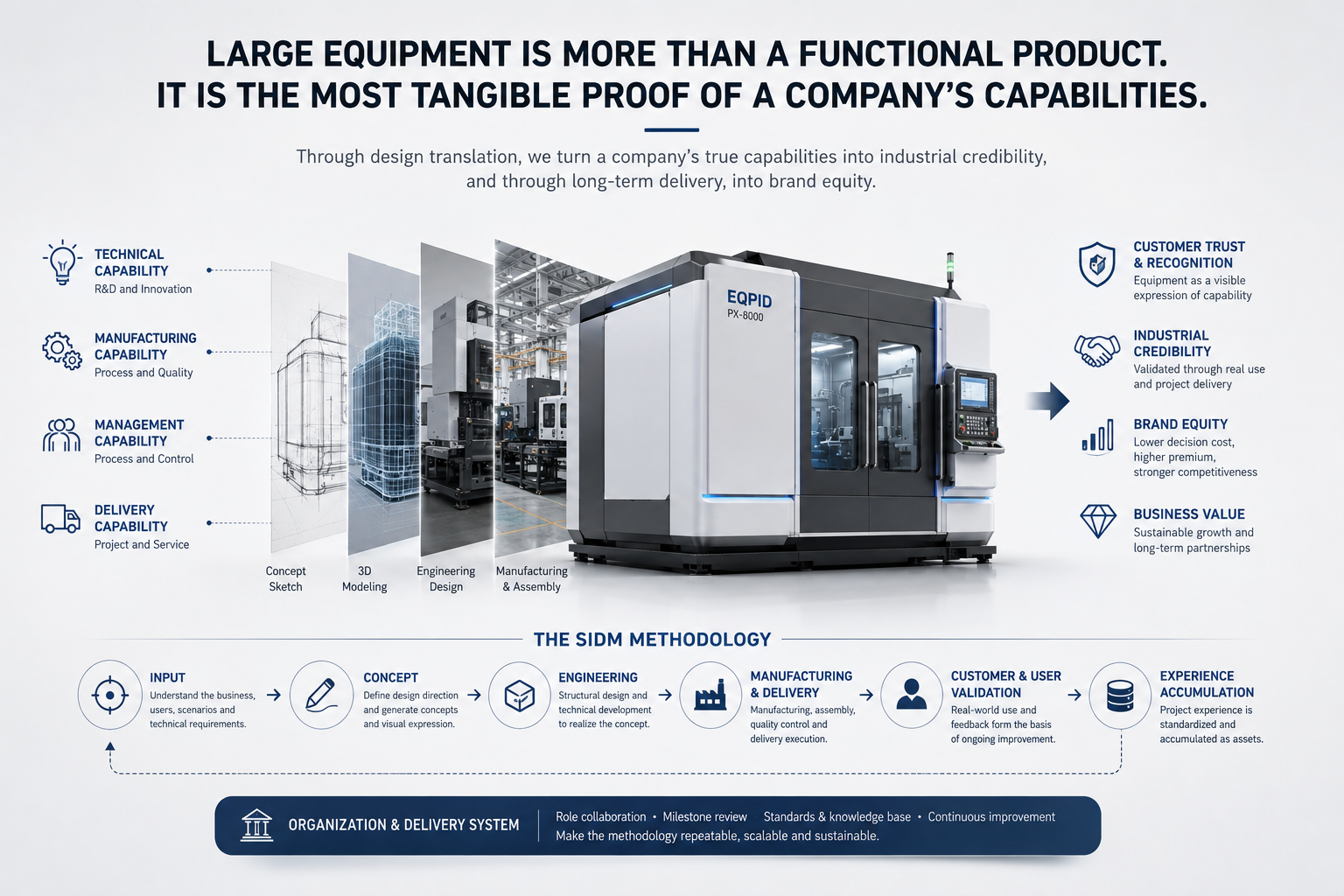
Large equipment is more than a functional product — it is a tangible proof of a company’s capabilities.
Preface to the EQPID Methodology
Why large-scale equipment is tangible proof of a company’s capabilities—and how design builds lasting industrial credibility.

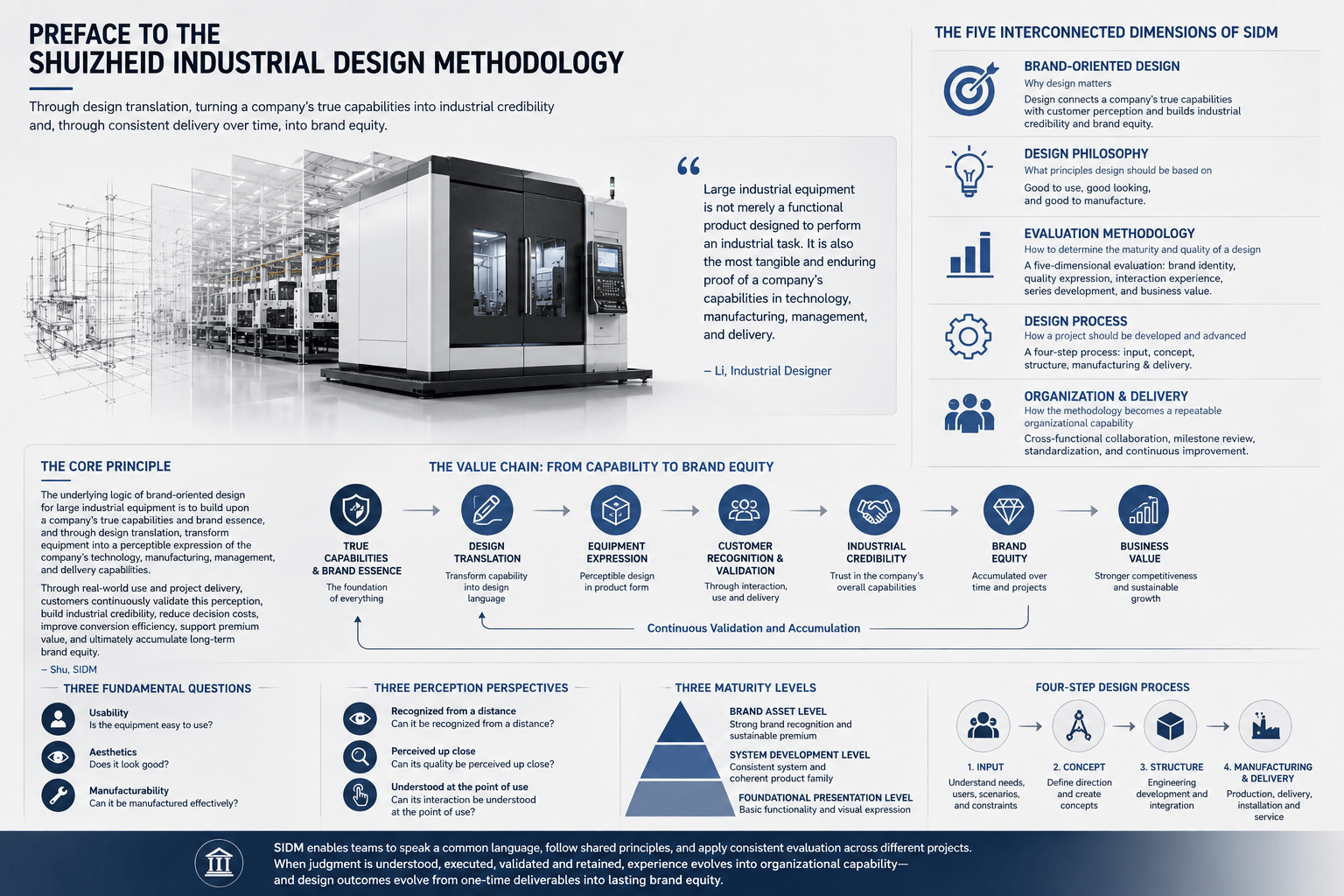
Large industrial equipment is not merely a functional product. It is tangible proof of a company’s capabilities in technology, manufacturing, management, and delivery.
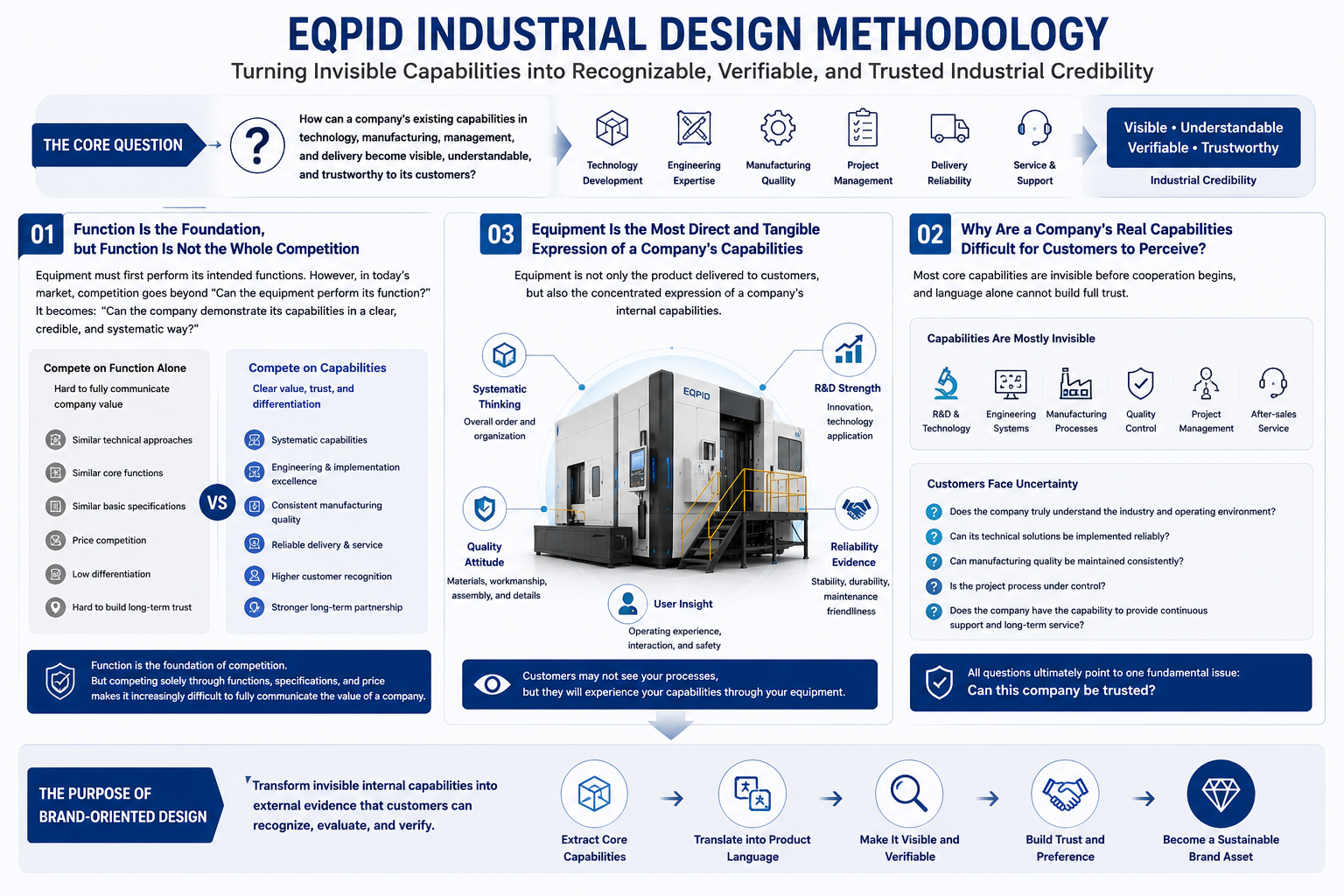
Since 2011, Shuizheid Industrial Design has continuously served companies in the large industrial equipment sector. Through years of project experience, we have observed that many companies do not lack technical expertise, manufacturing capabilities, or engineering experience. What they often lack is the ability to translate these capabilities into product expressions that customers can see, understand, and trust.
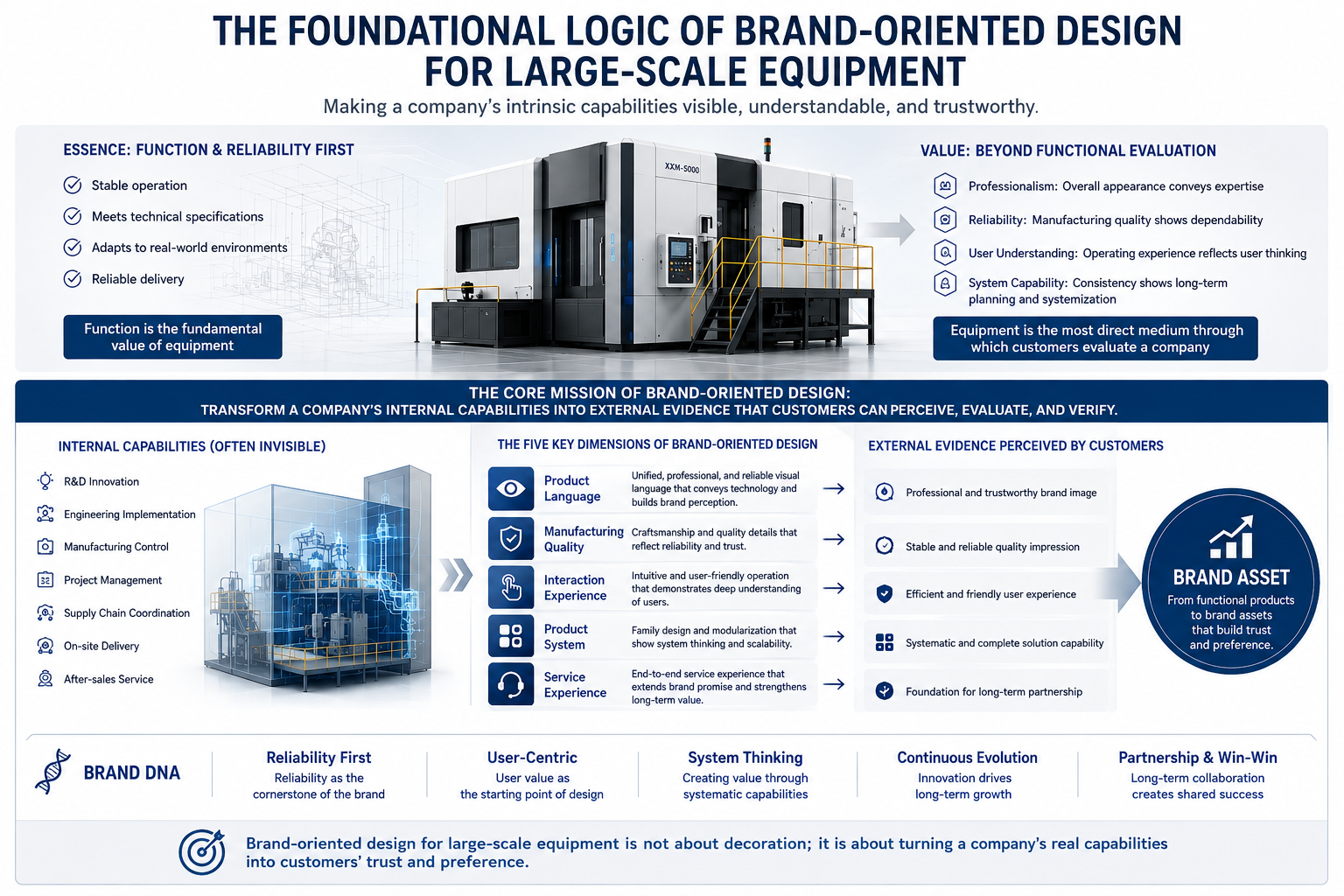
The capabilities that companies have built internally are often hidden within R&D processes, engineering expertise, manufacturing controls, and project management. Before entering into a formal partnership, customers cannot fully access or evaluate these internal systems. Instead, they form their judgments through the equipment itself, proposed solutions, manufacturing facilities, delivery performance, and service experience.
When equipment remains at the level of functional fulfillment, a company’s competitive advantage can easily be reduced to specifications, price, and delivery time. When equipment demonstrates clear identity, consistent quality, intuitive user experience, and a coherent product system, customers no longer see merely a machine. They begin to see whether the company behind it is capable of delivering on its promises consistently over the long term.
Industrial design, therefore, is not merely about shaping products. It is an important pathway through which a company’s capabilities enter customer perception, establish industrial credibility, and gradually accumulate into brand equity.
“Large industrial equipment is not merely a functional product designed to perform an industrial task. It is also the most tangible and enduring proof of a company’s capabilities in technology, manufacturing, management, and delivery.”
— Li, Industrial Designer
The Shuizheid Industrial Design Methodology was developed within this context. It is not an idealized process constructed from abstract theory. Rather, it is rooted in Shuizheid Industrial Design’s long-term experience working with 1,500+ clients and 3,000+ projects, as well as the real-world challenges repeatedly encountered across exterior design, structural engineering, sheet-metal manufacturing, assembly, delivery, and on-site customer use.
Our aim is to organize these accumulated experiences into a methodology that is understandable, assessable, executable, and reviewable.
This book proposes a fundamental principle:
“The underlying logic of brand-oriented design for large industrial equipment is to build upon a company’s true capabilities and brand essence, and through design translation, transform equipment into a perceptible expression of the company’s technology, manufacturing, management, and delivery capabilities. Customers can thereby recognize and understand these capabilities, and continuously validate their initial perception through product interaction, actual use, and project delivery. Over time, this process builds industrial credibility, reduces the cost of communication and decision-making, improves conversion efficiency, supports justified premium pricing, and ultimately accumulates into long-term brand equity.”
— Shu, SIDM
Based on this principle, SIDM establishes five interconnected dimensions:
Brand-Oriented Design — Why design matters
Design Philosophy — What principles design should be based on
Evaluation Methodology — How to determine the maturity and quality of a design
Design Process — How a project should be developed and advanced
Organization & Delivery — How the methodology can transcend individual designers and individual projects to become a repeatable organizational capability
This book does not attempt to expand industrial design into a discipline responsible for every aspect of large industrial equipment. Core technologies, process performance, control algorithms, engineering calculations, regulatory compliance, and certification should remain the responsibility of the corresponding specialist teams.
SIDM focuses on how industrial design can respect and build upon these foundations. Through product identity, functional organization, structural integration, interaction relationships, manufacturing collaboration, and brand systems, design can help a company’s true capabilities become better used, better expressed, better validated, and better accumulated.
The large industrial equipment industry encompasses a wide range of products. Equipment can vary significantly in function, structure, scale, production volume, and application environment. SIDM therefore does not provide a standardized styling template that can be mechanically replicated across projects. Instead, it provides a framework for making design judgments.
Different projects may require different priorities, but every project ultimately needs to address three fundamental questions:
Is the equipment easy to use?
Does it look good?
Can it be manufactured effectively?
And:
Can it be recognized from a distance?
Can its quality be perceived up close?
Can its interaction be understood at the point of use?
Finally:
Can the project progress reliably from input and concept development through structure and manufacturing to stable delivery?
The value of a methodology does not lie in making every project adopt the same form. It lies in enabling teams to use a common language, common principles, and common evaluation criteria when making decisions across different projects.
Only when judgment can be understood by the team, carried through the process, validated through manufacturing, and continuously applied to subsequent projects can experience evolve from individual capability into organizational capability.
And only then can design outcomes evolve from one-time project deliverables into lasting brand equity.
KEEP READING