
PART I · BRAND-ORIENTED DESIGN
Chapter 02 | Brand DNA: The Inner Source of Brand Expression for Large-Scale Equipment
A stable brand core. A coherent product expression.
How a company’s brand core becomes consistent product language, quality standards, and interaction experiences.

First determine what the company wants to express over the long term, then decide how the equipment should be presented.
— First determine what the company wants to express over the long term, then decide how the equipment should be presented.
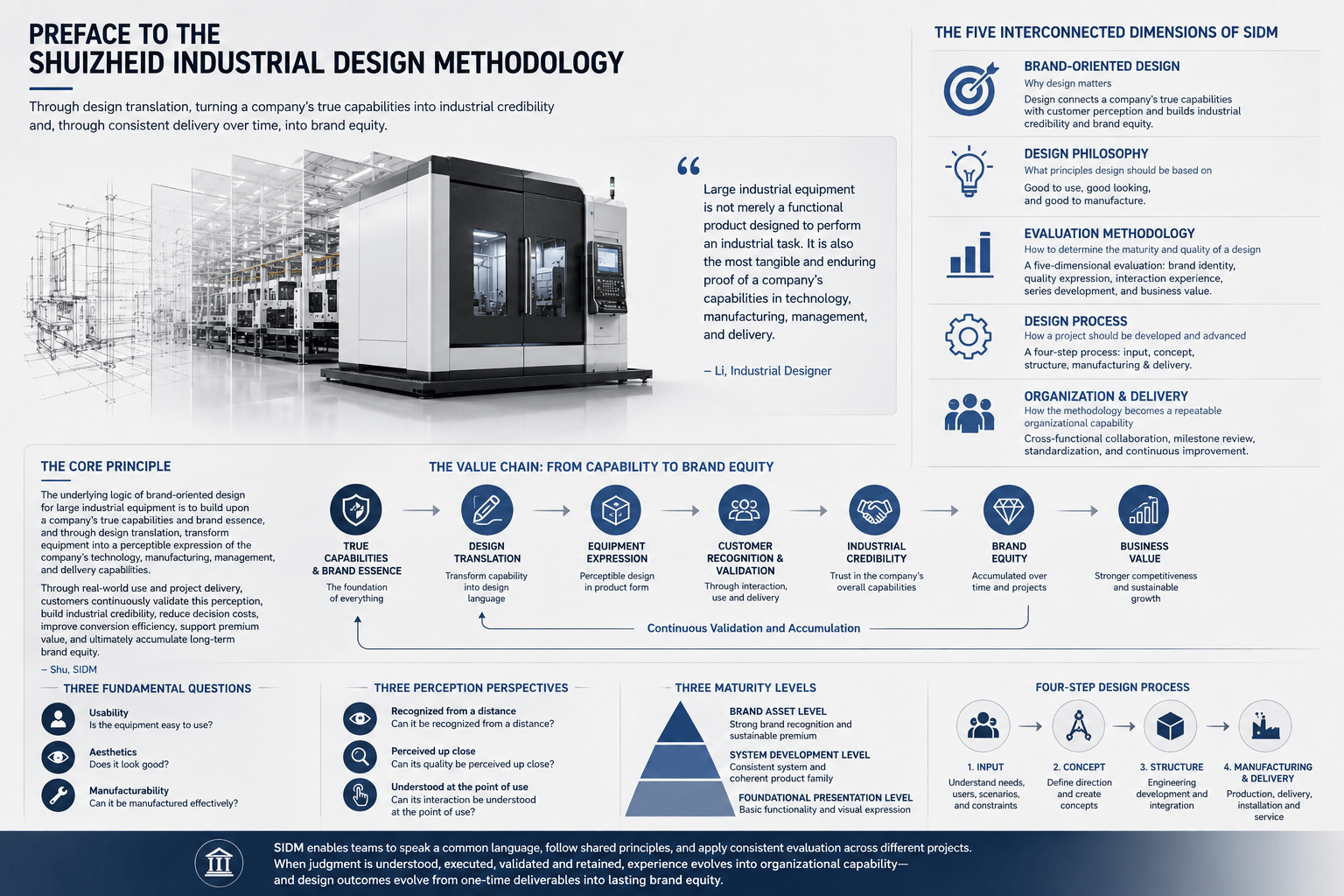
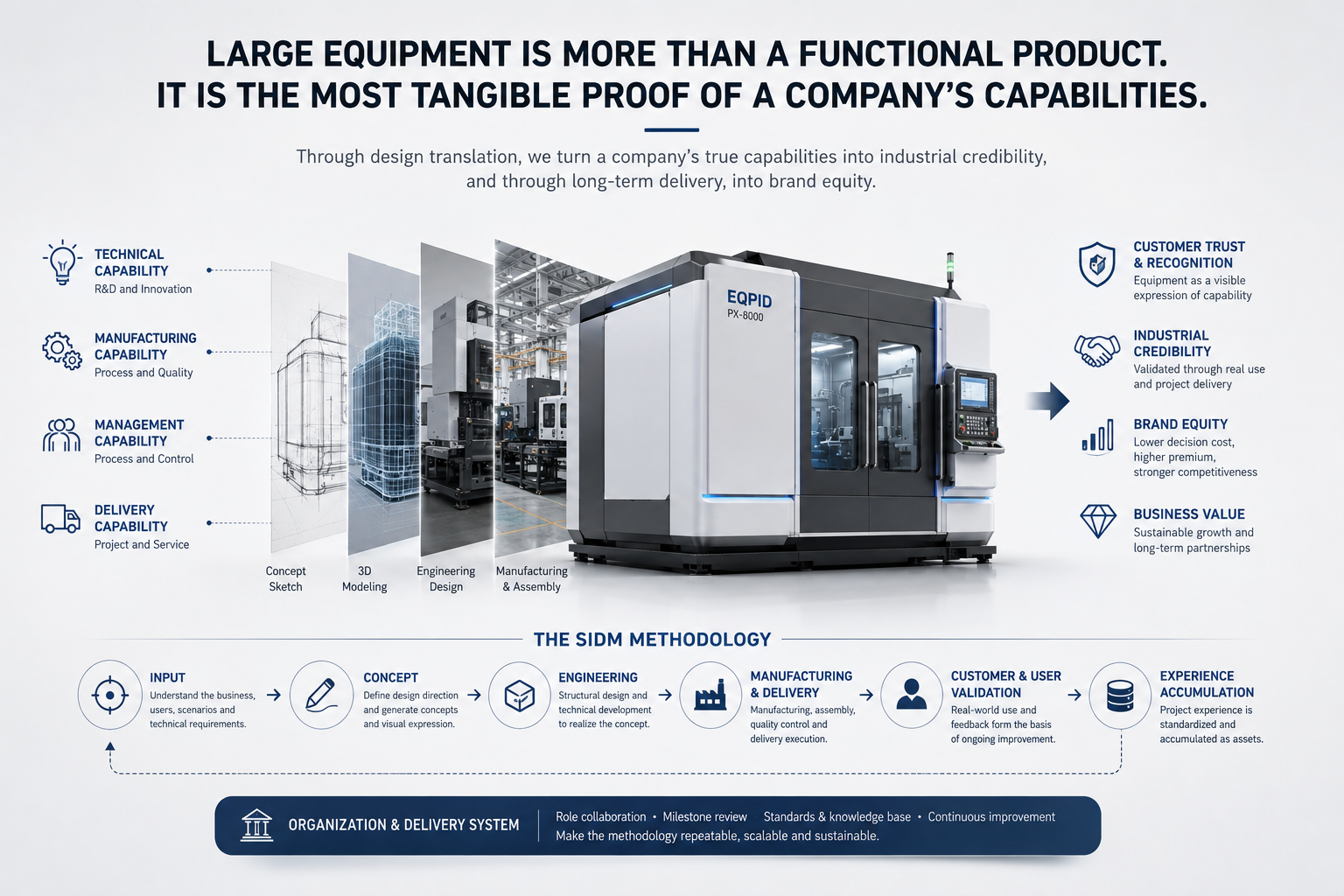
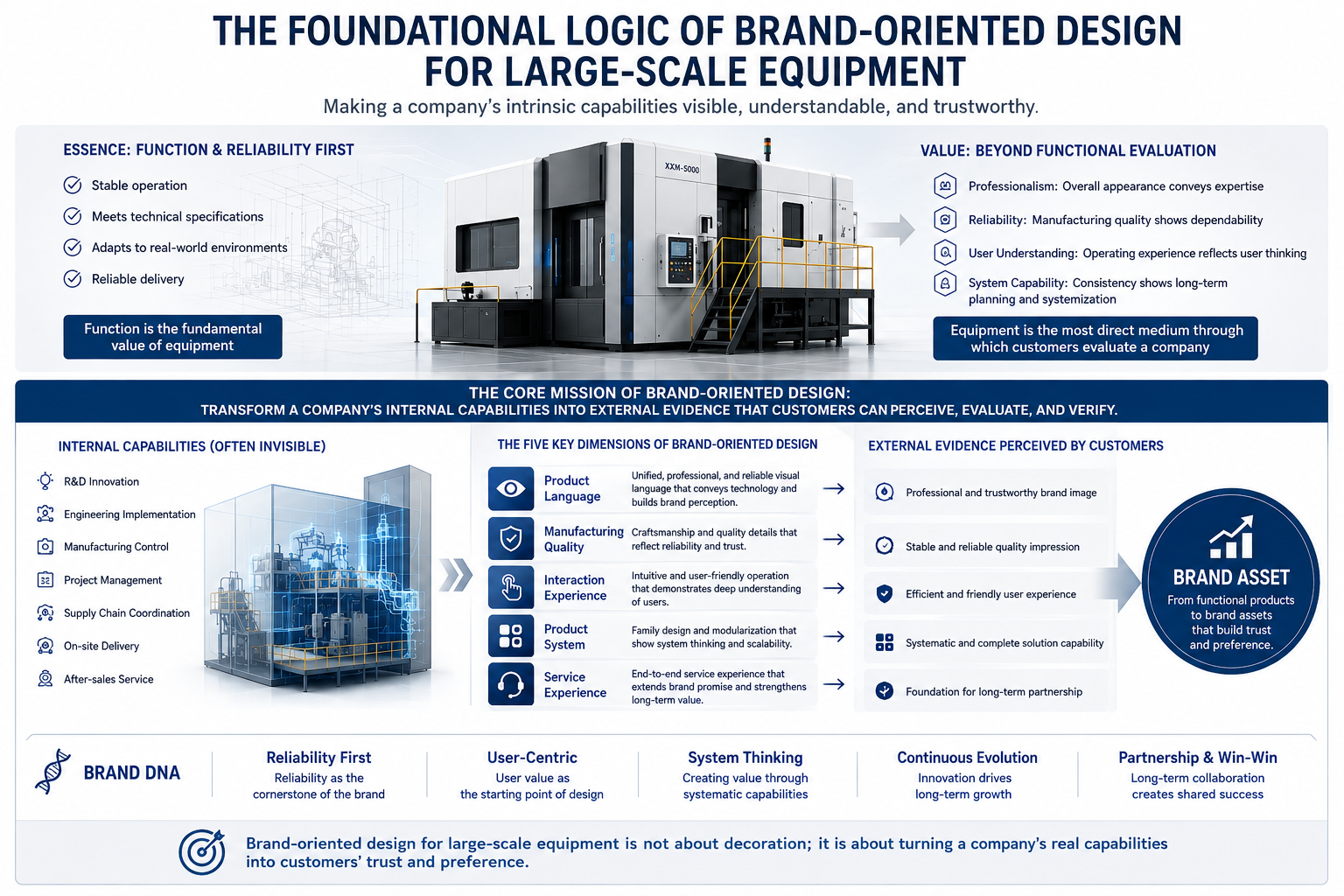
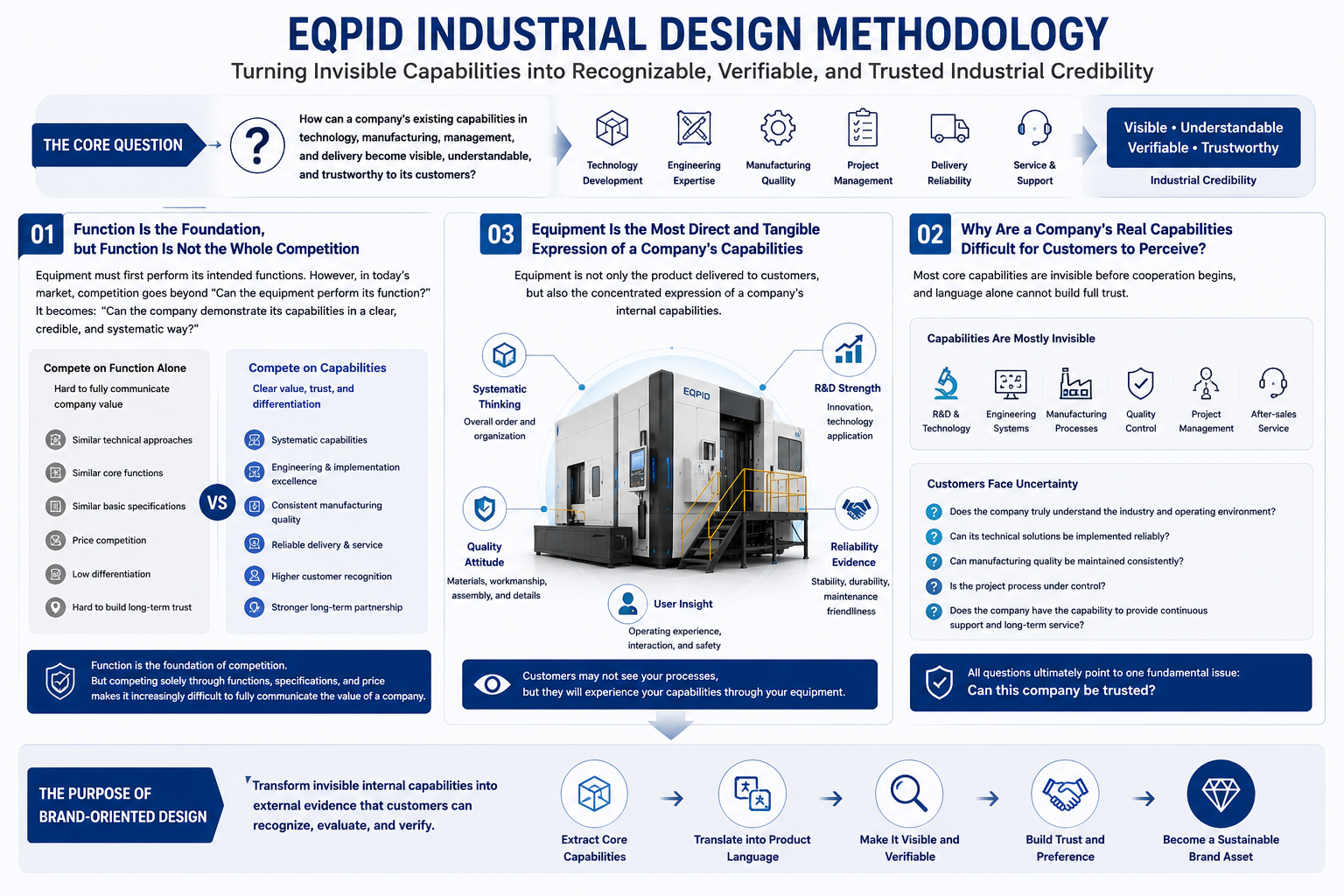
Chapter 01 established that the underlying logic of brand-oriented design for large-scale equipment is to use equipment as a tangible and perceivable carrier to transform the company's real capabilities—which are often difficult for customers to perceive—into industrial credibility that customers can recognize and evaluate.
However, a company's capabilities are usually complex and fragmented. Capabilities in technology, manufacturing, management, delivery, and service do not automatically form a clear and coherent brand expression. Different departments may understand the company from different perspectives; different products may adopt completely different design approaches; and different projects may present fragmented product identities due to variations in customer requirements, design teams, and manufacturing conditions.
Therefore, before a company's real capabilities can enter its large-scale equipment, another fundamental question must first be answered:
What does the company actually want to express over the long term?
Which values and capabilities best represent the company? What kind of brand perception should customers form after encountering its equipment? Which elements need to remain consistent over time, and which forms can evolve with products and changing times?
These questions ultimately point to Brand DNA.
01 — Brand-Oriented Design Does Not Begin with Form
In large-scale equipment design projects, companies often make relatively direct requests: they want the equipment to look more premium, more technological, more distinctive from competitors, or more consistent across different products. They may also want to establish a recognizable product identity of their own.
There is nothing inherently wrong with these requirements. However, terms such as “premium,” “technological,” “professional,” and “solid” are usually broad and ambiguous. If designers do not continue to explore how these qualities relate to the company's actual value, design can easily fall into formal imitation.
Designers may use large areas of dark colors, sharp lines, light strips, angled surfaces, and complex curves to express a so-called sense of technology. They may also use metallic materials, minimalist forms, and refined details to communicate a sense of premium quality.
But these formal elements can be adopted by almost any company. They cannot naturally become the distinctive characteristics of a particular brand.
True brand-oriented design should not only ask what color or form the equipment should use. It should ask deeper questions:
Why does the company want to express this particular character?
Which capability within the company does this character come from?
What is the company's position within its industry, and what value does it create for customers?
What does the customer most need to feel from the equipment—precision, reliability, efficiency, stability, innovation, openness, or something else?
Can these brand characteristics continue to be expressed across different types of equipment, different scales, and different operating environments?
If these questions remain unanswered, equipment may still achieve a strong visual impact, but it is likely to remain an isolated styling exercise rather than a genuine expression of the company's brand.
Brand-oriented design must first identify the company's stable and long-term internal foundation, and only then determine how that foundation should enter the product.
Brand DNA is the key bridge between a company's inner value and the external expression of its equipment.
“Brand-oriented design must first identify the company's stable and long-term internal foundation, and only then determine how that foundation should enter the product. Brand DNA is the key bridge between a company's inner value and the external expression of its equipment.”
— Li Design, Industrial Designer
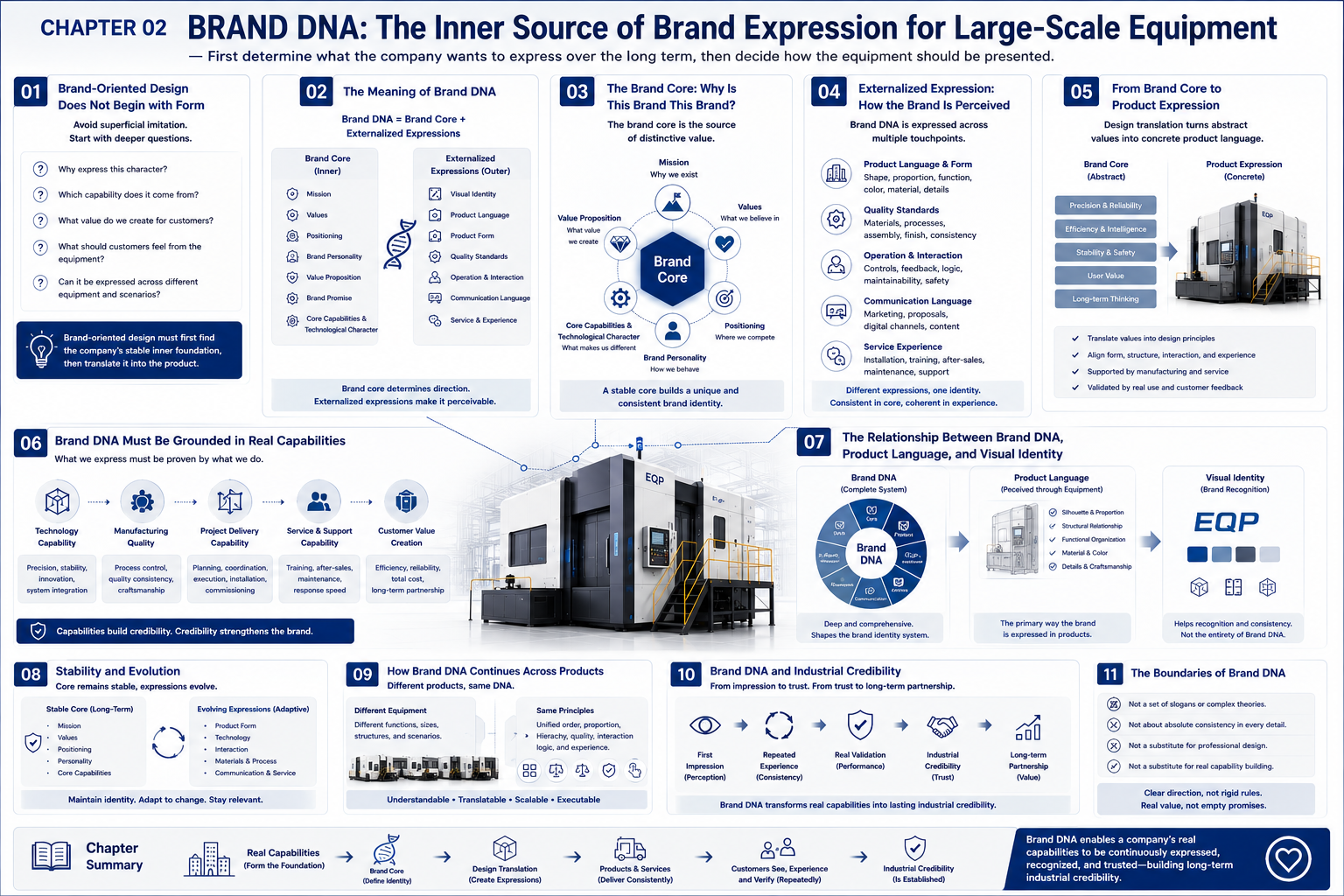
02 — The Basic Meaning of Brand DNA
In this book, Brand DNA can be understood as:
A brand identity system composed of a relatively stable brand core and the ways in which that core is continuously externalized and expressed.
This concept consists of two interconnected layers.
The First Layer: Brand Core
The brand core includes the company's relatively stable mission, values, brand positioning, brand personality, value proposition, brand promise, and representative core capabilities and technological character accumulated and selected over time.
These elements determine:
- Who the brand is
- Why it exists
- What it represents
- What it relies on to differentiate itself from other companies
The Second Layer: Externalized Expression
Externalized expression includes visual identity, product language, product form, quality standards, operating methods, interaction logic, communication language, service methods, and customer experience.
These are the perceivable elements through which the brand core moves from inside the organization into products, communications, services, and customer touchpoints, ultimately becoming something customers can recognize and understand.
Together, the brand core and its externalized expression form Brand DNA.
The brand core determines the direction of expression, while externalized expression makes that core visible and perceivable.
Without a stable core, external forms easily lose their foundation. Without continuous expression, the brand core has difficulty entering customer perception.
Therefore, Brand DNA is neither a collection of corporate culture slogans nor a particular form, brand color, or decorative feature.
It is a complete system that enables a brand to maintain identity continuity across different products, scenarios, and stages of development.
03 — The Brand Core: Why Is This Brand This Brand?
The brand core begins with the company's mission.
Mission answers why the company exists and what value it hopes to create for customers, industries, or society through its products and services.
For large-scale equipment companies, mission should not be limited to broad statements of vision. It should also relate to the industries the company serves over the long term, the problems it solves, and the responsibilities it undertakes.
The brand core also comes from values.
Values determine which principles the company maintains throughout product development, manufacturing, delivery, and customer relationships.
Whether a company prioritizes reliability, efficiency, long-term thinking, technological innovation, user value, or manufacturing quality will directly influence its products and services.
Brand positioning determines the position the company wants to occupy in the market.
Different large-scale equipment companies may serve different customer groups or build their competitive advantage around different capabilities.
Some may rely on high precision and stability. Others may compete through rapid response and flexible customization. Some may rely on system integration capabilities, while others may specialize in engineering and delivery for highly complex projects.
Brand positioning needs to answer:
How does the company most want to be recognized by customers, and why should customers choose it?
Brand personality gives these abstract elements a more consistent character.
Even when two brands both emphasize professionalism, they may express very different personalities.
One company may be professional and rigorous, while another may be professional and open.
One may be stable and restrained, while another may be proactive and ambitious.
Brand personality influences product form, communication style, interaction rhythm, and service attitude.
The company's core capabilities and technological character may also become part of the brand core.
However, not every capability a company possesses automatically belongs to its Brand DNA.
Only capabilities that have long-term significance, create meaningful differentiation, align with the brand positioning, and deserve to be continuously communicated to customers should become part of the brand core.
Therefore, the brand core is not simply a list of mission, values, positioning, and capabilities.
It is a relatively stable brand identity formed through the identification, selection, and organization of these fundamental elements.
04 — Externalized Expression: How the Brand Is Perceived by Customers
The brand core is invisible.
Customers cannot directly see a company's mission, values, or brand personality.
These elements must therefore be continuously expressed through perceivable forms before they can enter customer perception.
In the field of large-scale equipment, the product is one of the most important carriers through which Brand DNA becomes externalized.
The overall silhouette, proportions, formal relationships, functional zoning, colors, materials, and treatment of details communicate the basic character of the brand.
Clear and rigorous product organization may communicate professionalism and precision.
Stable and restrained formal relationships may communicate reliability and maturity.
An open and intuitive operating structure may communicate the company's emphasis on efficiency and user value.
Product quality
Product quality is another important expression of Brand DNA.
If a brand emphasizes precision, reliability, and professionalism, these qualities cannot be communicated through styling alone.
They must also be demonstrated through:
- Material selection
- Manufacturing processes
- Assembly precision
- Surface treatment
- Detail control
- Physical stability and consistency
Operation and interaction
Operating methods and interaction logic are also forms of brand expression.
How buttons are arranged, how information is presented, how abnormal conditions are communicated, how easily maintenance can be performed, and how clearly users can understand the operating process all reveal the company's understanding of its products, users, and operating environments.
Communication and service
Communication language and service experience continuously shape the brand as well.
Equipment promotion, sales communication, proposal presentations, installation and commissioning, training, and after-sales service all communicate who the company is.
If the product expression is professional and restrained while the communication language is exaggerated and chaotic, the brand identity becomes fragmented.
If the equipment emphasizes human-centered design while the service process is slow or unresponsive, customers will also perceive a contradiction.
Therefore, Brand DNA is not a single visual system.
It is the continuous expression of the brand core across different touchpoints, including:
Product · Quality · Interaction · Communication · Service
These expressions may take different forms, but they should ultimately point toward the same brand identity.
05 — How the Brand Core Becomes Product Expression
The brand core does not automatically become product form.
Mission, values, brand positioning, and brand personality are abstract concepts, while the form, structure, manufacturing, and interaction of large-scale equipment are concrete product elements.
A process of design translation is required between the two.
Design translation means transforming an abstract brand core into design principles that can be carried by the product, realized through manufacturing, and perceived by customers.
For example, suppose a company wants to communicate “precision and reliability.”
Simply placing these four words into a design brief is not enough to guide product design.
The design team needs to determine:
- What overall proportions communicate stability and accuracy?
- What formal relationships prevent visual disorder and arbitrariness?
- How should functional areas remain clearly organized?
- What kind of relationship should exist among doors, observation windows, operating areas, and maintenance areas?
- How should materials, processes, and assembly standards support the perception of precision?
Through this translation process, “precision and reliability” moves from an abstract value into concrete product language, quality standards, and experience principles.
Similarly, if a company wants to communicate “efficiency and intelligence,” simply adding light strips or a more complex interface does not create genuine intelligence.
True efficiency and intelligence should be translated into:
- Clearer information relationships
- Fewer unnecessary operations
- More accurate status feedback
- More rational functional organization
- Interaction logic that enables users to quickly understand and control the equipment
The essence of design translation is not to find superficial symbols for brand keywords.
It is to establish a correspondence between the brand core and product logic.
Only when this correspondence can be continuously validated through manufacturing, use, and service does brand expression become authentic.
06 — The Relationship Between Brand DNA and Real Capabilities
Brand DNA cannot exist independently of the company's real capabilities.
A brand can express capabilities the company already possesses, and it can appropriately point toward capabilities the company intends to develop over time.
But it cannot sustainably construct a brand image that is completely disconnected from reality.
If a company emphasizes reliability, the equipment should demonstrate reliability through:
Functional stability · Structural safety · Manufacturing quality · Delivery processes · Service responsiveness
If a company emphasizes precision, its products should demonstrate precision through:
Structural relationships · Assembly accuracy · Information expression · Quality control
If a company emphasizes efficiency, the equipment should reduce customers' time and resource consumption through:
Functional organization · Operating processes · Maintenance methods · Project delivery
When the content communicated by a brand cannot be supported by the real product, the positive impression initially formed by customers will eventually be broken through actual use and cooperation.
Large-scale equipment typically has a high purchase value, a long service life, and complex operating environments.
Brand expression will therefore be continuously tested by real projects.
Customers will not permanently trust a brand image that exists only in marketing materials. They will continuously revise their judgment based on equipment operation, manufacturing quality, delivery capability, and service outcomes.
Therefore:
Real organizational capability is the factual foundation of Brand DNA.
Brand DNA is not fictional packaging.
It is the extraction and organization of the company's real value, long-term capabilities, and future direction.
07 — The Relationship Between Brand DNA, Product Language, and Visual Identity
Product language is an important external expression of Brand DNA, but Brand DNA is not the same as product language.
Brand DNA includes both internal elements—such as mission, values, positioning, and personality—and external elements—such as product, visual identity, quality, interaction, communication, and service.
Product language focuses primarily on how the brand is perceived through product form, including:
- Silhouette
- Proportion
- Structural relationships
- Functional organization
- Colors and materials
- Detail treatment
Therefore, product language is one of the primary ways Brand DNA enters equipment, but it is not the entirety of Brand DNA.
Similarly, creating a product language does not mean that a complete Brand DNA system has already been established.
If the product language has no connection to the company's core and is merely based on an individual designer's personal style, it may have visual character but cannot easily become a stable long-term brand expression.
If product language appears on only one piece of equipment and cannot continue into subsequent products, it remains a one-off project outcome.
If product language is consistently applied across different products but conflicts with quality, interaction, communication, or service, the brand perception remains incomplete.
Product language gains genuine Brand DNA significance only when it continuously carries the brand core and works together with quality standards, interaction experience, communication language, and service behavior to form a coherent expression.
Visual identity
A visual identity system usually includes:
Logo · Typeface · Brand colors · Graphic elements · Layout principles
These elements help customers quickly recognize the brand and are important components of brand expression.
But Brand DNA cannot be reduced to visual identity.
A large-scale equipment company may use the same brand colors and logo across every product and still lack a mature Brand DNA system.
Different products may share the same colors but lack common formal logic.
Equipment may have a highly consistent appearance while operation and quality standards vary significantly.
Marketing materials may follow a complete visual identity system while the physical equipment fails to support the brand positioning.
Therefore:
Visual identity helps customers recognize the brand.
Product language helps customers understand the brand through equipment.
Quality and interaction help customers believe in and verify the brand.
Communication and service further develop the customer relationship.
Brand DNA is deeper than visual identity and is much closer to the company's long-term brand identity.
08 — The Stability and Evolution of Brand DNA
Brand DNA needs stability, but stability does not mean that everything must remain unchanged forever.
Core elements within the brand DNA—such as mission, fundamental values, positioning, and brand personality—usually have long lifecycles.
They form the foundation of brand identity and should not change frequently because of a single project, management change, or short-term market trend.
If a company emphasizes precision and reliability today, youthful energy tomorrow, and luxury and premium quality the day after, customers will struggle to develop a stable understanding of the brand.
However, the external expression of Brand DNA needs to evolve with:
- Company development
- Product changes
- Technological progress
- Market conditions
- Customer needs
Equipment forms can evolve.
Materials and manufacturing processes can be upgraded.
Interaction methods can change with digital technology.
Communication and service methods can adapt to new customer expectations.
A mature Brand DNA system does not use a fixed template to restrict every product.
Instead, it establishes an adaptable expression system under a stable brand core.
This relationship can be summarized as:
The core remains stable over the long term; expressions evolve appropriately.
Core identity remains continuous; specific forms adapt to context.
Brand characteristics may evolve, but they must never lose their origin or direction.
Brand DNA evolution is not about rejecting the past.
It is about continuously improving expression while preserving the core identity.
A mature brand allows customers to see change while still recognizing that it is the same brand.
09 — How Brand DNA Continues Across Products
Large-scale equipment is often complex in function, highly varied in scale, diverse in structure, and heavily customized according to customer requirements.
Therefore, Brand DNA cannot depend on mechanically reproducing one fixed form across every product.
A compact inspection machine and a large automated production line may differ dramatically in:
- Scale
- Structure
- Function
- Operating environment
Requiring them to use exactly the same external form is neither realistic nor necessarily beneficial to function and manufacturing.
Brand DNA needs to be carried through deeper design principles.
These principles may include:
- Proportional logic
- Functional organization
- Hierarchy and emphasis
- Color and material principles
- Quality standards
- Information structure
- Interaction methods
Different products may have different forms while still sharing the same underlying brand order.
Large-scale equipment companies also frequently collaborate with different external design firms, structural engineering teams, and manufacturing suppliers.
The continuity of Brand DNA should not depend on the personal experience of a particular designer.
Instead, it needs to gradually become embedded in:
Design principles · Quality standards · Product guidelines · Collaboration frameworks
A truly mature Brand DNA system should be:
Understandable · Translatable · Scalable · Executable
Whether the work is carried out by internal teams or external partners, as long as they can accurately understand the brand core and follow the common principles of expression, the brand identity can continue across products.
10 — Brand DNA and Industrial Credibility
Brand DNA gives the expression of a company's capabilities a clear direction and long-term continuity.
A company may possess many capabilities, but customers do not necessarily see all of them.
Brand DNA helps the company identify the values and capabilities that are most worth expressing over the long term, and continuously present them through:
Product · Quality · Interaction · Service
When customers encounter the equipment for the first time, they may simply perceive professionalism, reliability, or precision.
When they repeatedly encounter the same characteristics across different products and projects, they gradually begin to associate those characteristics with the company itself.
Customers may see clear and orderly product forms and infer systematic capabilities.
They may see stable and consistent quality standards and infer manufacturing and management capabilities.
They may experience mature operation and service and infer the company's understanding of users and projects.
As these judgments are repeatedly validated through actual use and project delivery, they gradually form industrial credibility.
Without Brand DNA, the expression of a company's capabilities can easily become fragmented.
One machine may emphasize technology, another may emphasize power, while another may pursue decorative styling.
Different projects may also have completely different quality standards and interaction logic.
Customers may recognize an individual machine, but that recognition is difficult to transfer consistently to the company as a whole.
Brand DNA transforms equipment expression from a one-time impression into a long-term identity.
It enables customers' judgments of individual products to gradually become judgments of the company's capabilities.
In this sense:
Brand DNA is an important mechanism through which a company's real capabilities are continuously transformed into industrial credibility.
11 — The Boundaries of Brand DNA
Brand DNA is not about artificially constructing a complicated conceptual framework.
Nor does it mean that a company must complete every mission, value, and positioning document before beginning brand development.
Some large-scale equipment companies may not have systematically organized their brand core, yet through years of operation they have already developed relatively stable value choices, technological characteristics, and customer perceptions.
One important task of Brand DNA development is therefore to identify these long-term characteristics from the company's:
History · Product capabilities · Customer feedback · Development direction
and gradually make them explicit.
Brand DNA also does not require every product and every touchpoint to be completely identical.
Consistency does not mean superficial replication.
It means consistency in brand identity and value direction.
Different equipment can have different expressions based on function, cost, operating environment, and manufacturing conditions, as long as those variations continue to serve the same brand core.
Brand DNA cannot replace product design either.
Defining the brand core does not automatically produce a product form.
Design still needs to resolve numerous concrete issues involving:
Function · Structure · Proportion · Manufacturing · Interaction · Context
Brand DNA provides direction and criteria for design decisions, but it does not replace the professional design process.
Likewise, Brand DNA cannot replace capability building.
If product quality, manufacturing management, delivery, and service remain unstable, a brand language and visual identity system alone cannot create genuine brand credibility.
12 — Chapter Summary
Brand-oriented design for large-scale equipment should not begin with isolated styling.
It should first determine what the company wants to continuously express through its equipment.
Brand DNA is a brand identity system composed of a relatively stable brand core and its continuously externalized expressions.
The brand core determines who the company is, what it represents, and the direction of product expression.
Externalized expression brings the brand core into customer perception through:
Product Language · Quality Standards · Interaction Logic · Communication Language · Service Experience
The brand core should remain relatively stable, while its forms of expression can evolve appropriately according to products, technology, and market changes.
However, this evolution must always maintain continuity of brand identity.
Brand DNA must also be grounded in the company's real capabilities.
If a company communicates professionalism, precision, reliability, efficiency, or intelligence, these qualities must be continuously validated through technology, manufacturing, use, delivery, and service.
The core value of Brand DNA is to prevent the expression of a company's capabilities from becoming fragmented, accidental, or short-lived.
Instead, it enables those capabilities to be continuously expressed across different equipment, projects, and customer touchpoints.
The fundamental logic can therefore be summarized as:
Real capabilities form the foundation of the brand.
The brand core defines its long-term identity.
Design translation creates perceivable expressions.
Products and services continuously present the brand characteristics.
Customers form stable judgments through repeated exposure and real-world validation.
Brand DNA therefore enables a company's capabilities to gradually transform into industrial credibility.
KEEP READING