
PART I · BRAND-ORIENTED DESIGN
Chapter 01 — EQPID Industrial Design Methodology
From invisible capabilities to industrial credibility
How design makes a company’s capabilities recognizable, understandable, and verifiable through its equipment.

Turning Invisible Capabilities into Recognizable, Verifiable, and Trusted Industrial Credibility
Brand-oriented design for large-scale equipment does not begin with appearance, nor does it begin by adding more logos, brand colors, or visual elements to a machine.
It begins with a more fundamental question:
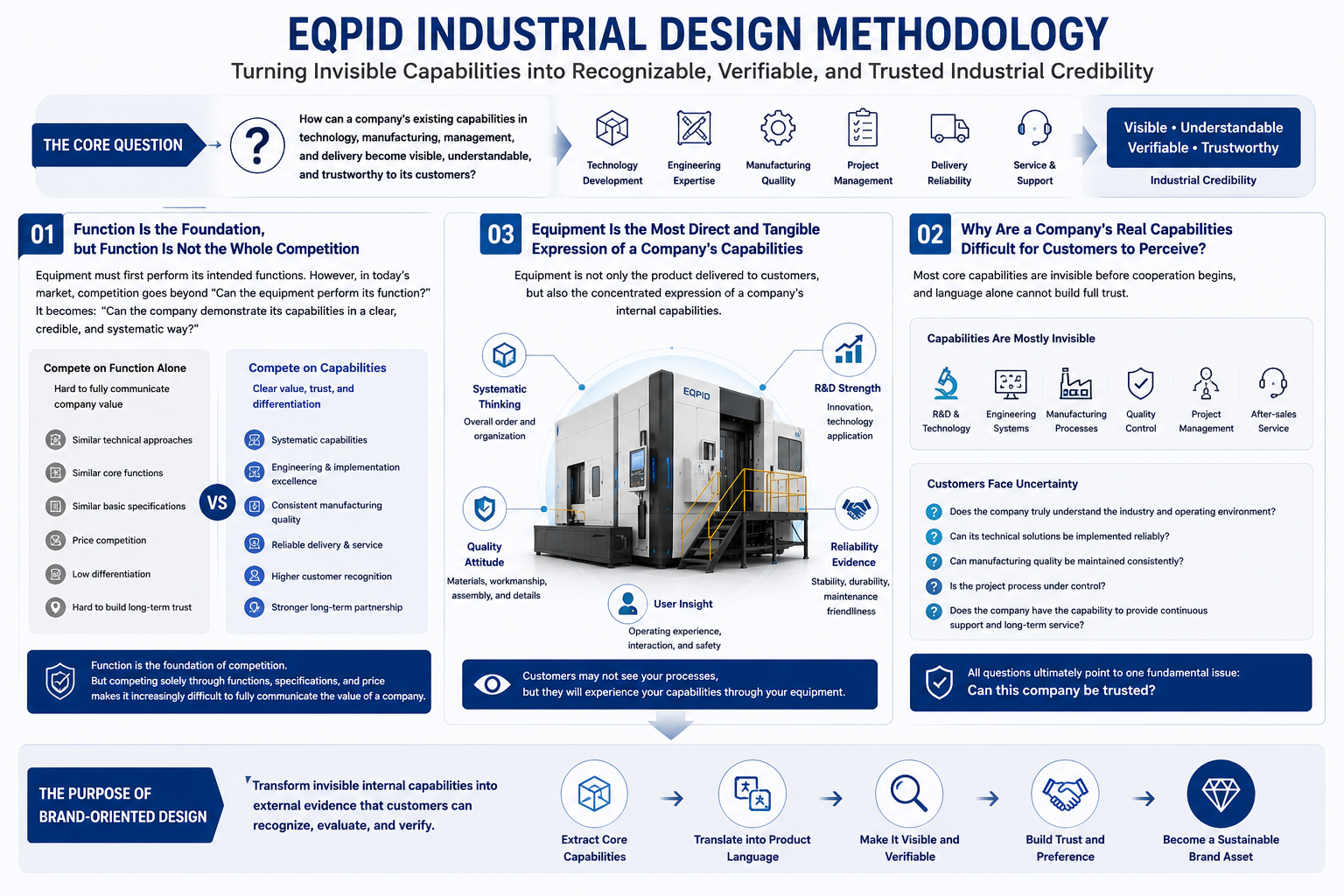
How can a company's existing capabilities in technology, manufacturing, management, and delivery become visible, understandable, and trustworthy to its customers?
01 — Function Is the Foundation, but Function Is Not the Whole Competition
Large-scale equipment must first fulfill its intended technical purpose. It needs to meet requirements for performance, efficiency, precision, safety, reliability, service life, and adaptability to real-world operating environments.
Without functional value, equipment loses its fundamental reason to exist. Without genuine technical and manufacturing capabilities, brand-oriented design has no solid foundation.
However, meeting functional requirements does not necessarily lead to customer recognition.
In many large-scale equipment industries, competing companies are increasingly similar in terms of technical approaches, core functions, and basic specifications. When customers evaluate multiple suppliers, it can be difficult to determine which company is more professional, reliable, and worthy of long-term cooperation based solely on technical specifications.
Even when functional performance is similar, significant differences may still exist in engineering capability, manufacturing quality, project management, delivery reliability, and service.
As a result, competition in the large-scale equipment market is gradually moving beyond the simple question of “Can the equipment perform its function?”
It is increasingly becoming a question of:
“Can the company demonstrate its capabilities in a clear, credible, and systematic way?”
Function remains the foundation of competition. But competing solely through functions, specifications, and price makes it increasingly difficult to fully communicate the value of a company.
— Li Design, Industrial Designer
02 — Why Are a Company's Real Capabilities Difficult for Customers to Perceive?
The competitiveness of a large-scale equipment company rarely comes from a single capability.
It may be built upon years of technological development, deep knowledge of industrial processes, mature engineering expertise, a stable supply chain, reliable manufacturing quality, disciplined project management, and experience delivering complex projects in demanding environments.
Together, these capabilities determine whether a company can provide stable and reliable equipment.
Yet most of them remain hidden inside the organization.
Before entering into a formal partnership, customers usually cannot fully access a company's R&D, engineering, manufacturing, or management systems. Nor can they accurately evaluate long-term equipment performance before the project has actually been delivered and operated.
Even a factory visit may provide only a limited view of the company's true capabilities within a short period of time.
Companies can explain their strengths through sales presentations, technical proposals, marketing materials, and project portfolios. However, language has an inherent limitation.
Almost every company claims to be professional, reliable, advanced, and experienced.
Without tangible evidence, customers have difficulty determining whether these claims reflect genuine capabilities or simply conventional marketing language.
Large-scale equipment typically involves high purchase values, long decision cycles, and multiple stakeholders. If technical deviations, manufacturing problems, or delivery delays occur, the resulting losses can far exceed the purchase price of the equipment itself.
Therefore, customers are not only concerned with what the equipment can do.
They also need to understand:
- Does the company truly understand the industry and operating environment?
- Can its technical solutions be implemented reliably?
- Can manufacturing quality be maintained consistently?
- Is the project process under control?
- Does the company have the capability to provide continuous support and long-term service?
All of these questions ultimately point to one fundamental issue:
Can this company be trusted?
03 — Equipment Is the Most Direct and Tangible Expression of a Company's Capabilities
In the large-scale equipment industry, equipment is not only the final product delivered to the customer.
It is also a concentrated expression of the company's internal capabilities.
Customers cannot directly see a company's management systems. But they can sense whether the company has a systematic approach through the overall order and organization of its equipment.
They cannot fully observe the quality-control processes behind manufacturing. But they can evaluate the company's attitude toward quality through materials, workmanship, assembly, and details.
They cannot directly observe how the R&D team understands users. But they can evaluate that understanding through operation, visibility, maintenance, safety, and the relationship between different functional areas.
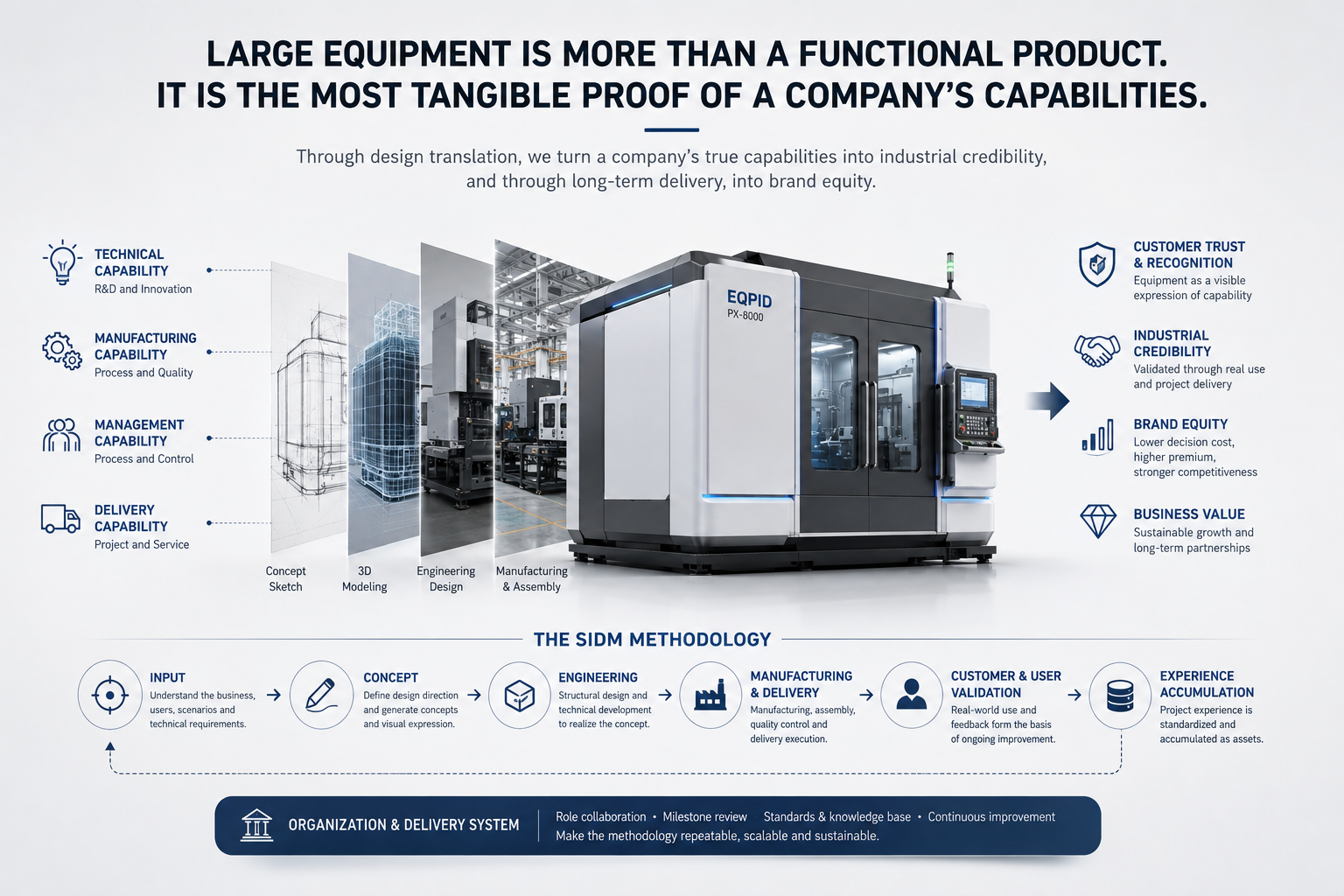
Equipment transforms abstract, fragmented, and invisible internal capabilities into tangible results that customers can directly experience.
The overall clarity and order of the equipment reflects the company's ability to organize complex functions and structural relationships.
Consistent product quality reflects its engineering, manufacturing, and quality-management capabilities.
A smooth interaction experience reflects its understanding of users and real-world operating environments.
Consistency across different products reflects whether the company possesses long-term product planning and brand-building capabilities.
Large-scale equipment also has a long physical presence and a wide range of touchpoints.
A machine may operate at a customer's facility for years. It may also appear in exhibitions, showrooms, websites, product brochures, case studies, and sales presentations.
It is not a temporary communication asset.
It is a long-term brand carrier that continuously represents and validates the company.
Advertising can tell customers what a company wants to become.
Equipment continuously demonstrates what the company actually is.
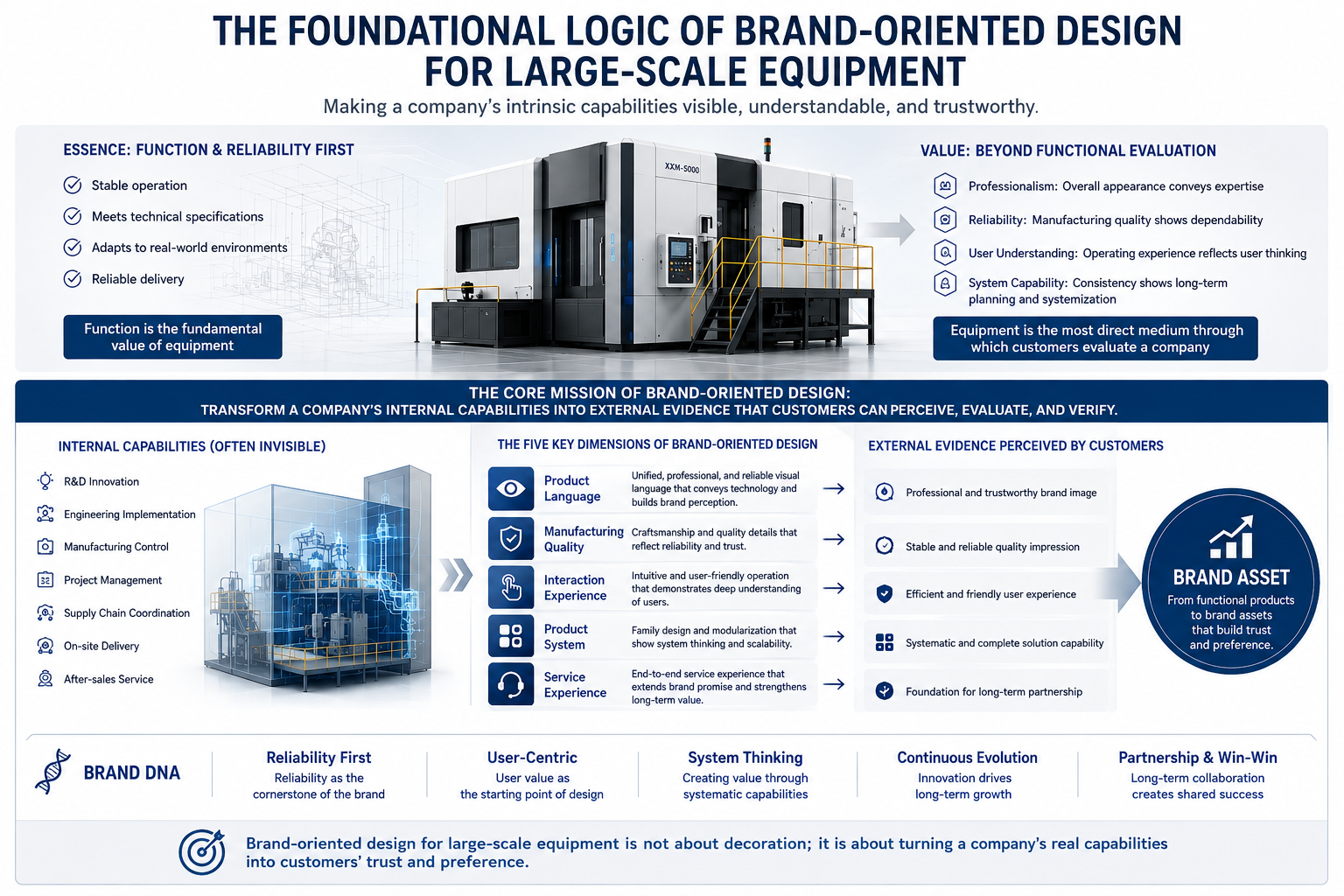
Therefore, the primary purpose of brand-oriented design for large-scale equipment is not simply to make the equipment more noticeable.
It is to make the equipment a more accurate, complete, and credible representation of the company behind it.
04 — From Internal Capabilities to Industrial Credibility
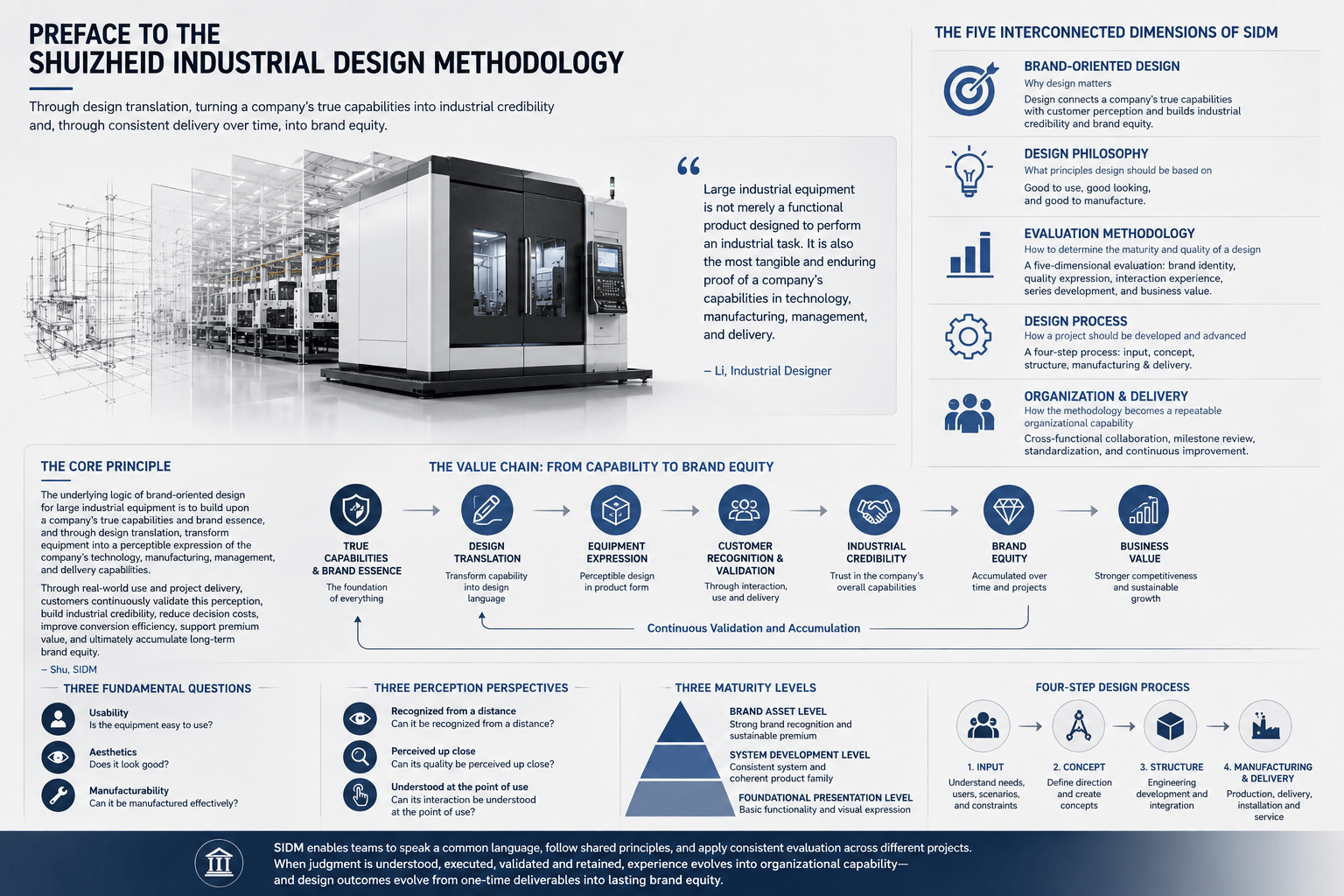
Based on the above understanding, Shuizheid Industrial Design defines the underlying logic of brand-oriented design for large-scale equipment as follows:
“The underlying logic of brand-oriented design for large-scale equipment is to use a company's genuine capabilities and brand core as the foundation, and through design translation, turn the equipment into a tangible expression of its technological, manufacturing, management, and delivery capabilities. Customers can then recognize and understand these capabilities through the equipment, while validating their initial judgment through product interaction, actual use, and project delivery. Over time, this process builds industrial credibility, reduces communication and decision-making costs, improves conversion efficiency, supports reasonable premium pricing, and accumulates into brand assets that ultimately generate long-term business value.”
— Shuai, SIDM
Here, industrial credibility refers to the comprehensive judgment and trust that customers develop regarding a company's technological, manufacturing, management, and delivery capabilities through its equipment and related customer touchpoints.
Industrial credibility cannot simply be declared by a company, nor can it be established through brand awareness alone.
It must be gradually built through tangible product performance and real project outcomes.
When customers see equipment with clear product organization, logical functional relationships, consistent manufacturing quality, and mature interaction, they naturally begin to make broader judgments about the company:
Its technology may be more systematic.
Its engineering capabilities may be more mature.
Its manufacturing processes may be more stable.
Its quality management may be more disciplined.
Its project delivery may be more reliable.
Customers are, in effect, using the equipment to evaluate the company behind it.
This judgment may not always be completely accurate, but it genuinely exists in the purchasing and partnership decisions surrounding large-scale equipment.
The overall appearance, manufacturing details, information structure, and interaction experience of equipment can all become evidence through which customers understand a company.
When the image, quality, and experience presented by the equipment remain consistent with the capabilities the company claims to possess, customer trust gradually increases.
When the external expression of the equipment conflicts with its actual quality, usability, or delivery performance, trust can quickly decline.
Therefore, brand-oriented design must not only answer:
“What do we want customers to see?”
It must also answer:
“Is what customers see authentic, and can it continue to be validated through manufacturing, use, and delivery?”
Ultimately, industrial credibility is the result of long-term consistency between what a company communicates and what it can actually deliver.
05 — The Value Conversion Chain of Brand-Oriented Design
Brand-oriented design for large-scale equipment does not directly create a company's technological or manufacturing capabilities.
Instead, it helps transform capabilities that already exist into capabilities that customers can recognize.
This process can be summarized as:
Real Capabilities → Tangible Product Expression → Customer Recognition & Evaluation → Industrial Credibility → Brand Assets → Business Value
— Shuai, SIDM
Real capabilities are the starting point of the entire process.
Without genuine technological, manufacturing, management, and delivery capabilities, brand-oriented design has no reliable foundation.
Design can improve how capabilities are expressed, but it cannot replace those capabilities over the long term.
Tangible product expression is the critical stage through which capabilities enter customer perception.
A company's brand positioning, technological character, and core capabilities need to be expressed through product language, quality, interaction experience, information design, and product systems.
Customers do not directly perceive the company's internal capabilities.
They form judgments through these tangible expressions.
Customer recognition and evaluation mark the point at which value transformation truly begins.
When customers can quickly recognize a company's products, understand the professionalism, reliability, and differentiation they communicate, and connect these characteristics with the company's underlying capabilities, the equipment begins to function as both a brand communication tool and evidence of capability.
Industrial credibility is the result of repeated observation and validation.
It may begin with a professional impression formed during the first encounter with a product. It may then develop through long-term use, consistent delivery, and repeated cooperation.
As these judgments continue to be validated, customer perception gradually evolves from an initial impression into relatively stable trust.
Brand assets emerge when industrial credibility accumulates over time.
When customers encounter a company's equipment and no longer need to understand the company from scratch, when the market can form relatively stable expectations based on previous products and projects, and when product language, quality standards, and interaction principles can be consistently carried across future products, the brand begins to become a reusable business asset.
Ultimately, these brand assets enter the company's operations through:
- lower communication costs
- higher conversion efficiency
- stronger pricing power
- customer referrals
- long-term partnerships
- stronger market competitiveness
and ultimately generate business value.
06 — How Industrial Credibility Enters Business Operations
1. Industrial credibility reduces communication costs
In traditional industrial projects, sales and technical teams often need to repeatedly explain a company's capabilities, manufacturing standards, project experience, and quality advantages.
Because these concepts are relatively abstract, companies must invest significant time in proposals, factory visits, case presentations, and face-to-face communication to help customers form an informed judgment.
When equipment can clearly express the company's capabilities, it can take over part of this communication role.
A product with clear brand recognition can help customers remember the company more easily.
Consistent quality expression can communicate the company's manufacturing and delivery standards.
A mature interaction experience can demonstrate a genuine understanding of users and operating environments.
A coherent product family can demonstrate that the company has developed a systematic product capability rather than relying on isolated design projects.
Equipment cannot replace sales, engineering, or project communication.
But it can reduce the friction involved in explaining the company and improve the efficiency with which customers understand its value.
Reducing communication costs is not simply about saving presentation time.
More importantly, it reduces the loss of value that can occur while a company's capabilities are being communicated.
2. Industrial credibility improves conversion efficiency
The decision-making process for large-scale equipment fundamentally involves evaluating future cooperation risk.
The higher the equipment value, the more complex the system, and the longer the delivery cycle, the more customers need confidence that the company can reliably deliver what it promises.
Even when a company's technical proposal offers strong specifications, customers may delay a decision—or choose a more familiar supplier—if they lack confidence in its engineering, manufacturing, or delivery capabilities.
When equipment consistently communicates professionalism, order, reliability, and maturity, customers are more likely to believe that the company is capable of delivering complex projects.
Brand-oriented design cannot determine a sale on its own.
But it can reduce the friction involved in understanding and trusting a company, increasing the likelihood that it will:
- enter the customer's consideration set
- gain deeper communication opportunities
- be shortlisted
- receive priority during supplier evaluation
3. Industrial credibility strengthens pricing power
Premium pricing for large-scale equipment does not come from surface decoration, nor can sustainable pricing power be built through price increases that are disconnected from real value.
Sustainable premium comes from the customer's evaluation of a company's overall capabilities and the risks associated with cooperation.
When customers believe that a company can provide more consistent quality, a more mature user experience, a more disciplined project process, and more reliable delivery, price evaluation moves beyond materials and technical specifications.
Customers begin to consider:
- long-term operating costs
- project risks
- maintenance efficiency
- delivery certainty
- long-term cooperation value
What a brand ultimately provides is a sense of certainty.
The stronger that certainty becomes, the more willing customers are to pay a reasonable premium for lower risk, more reliable delivery, and greater long-term value.
Therefore, the role of brand-oriented design in supporting premium pricing is not to make equipment look more expensive.
It is to make the company's genuine value easier to recognize, so customers can understand why the company deserves a higher price.
07 — The Boundaries of Brand-Oriented Design
Brand-oriented design can translate capabilities.
It cannot replace them.
It cannot use visual identity to conceal technological weaknesses.
It cannot use premium styling to compensate for poor manufacturing.
It cannot use marketing language to replace reliable delivery.
If the professionalism, precision, reliability, and efficiency communicated by the equipment cannot be validated through its functionality, quality, usability, and service, brand-oriented design will not create credibility.
Instead, it may amplify customer disappointment.
Therefore, brand-oriented design for large-scale equipment must always be grounded in genuine organizational capabilities and realized through collaboration between:
Design → Engineering → Manufacturing → Delivery
It is not about packaging a company as something it is not.
It is about helping the company translate its genuine, important, and differentiated capabilities into product value that customers can actually perceive.
Brand-oriented design should also not be understood simply as a one-time exterior redesign.
A single machine can become the starting point for brand building.
But brand assets require continuous accumulation across multiple products, projects, and delivery experiences.
Ultimately, brand-oriented design is not about how one particular machine looks.
It is about whether a company can build a consistent brand identity, industrial credibility, and long-term value through its equipment.
08 — Chapter Summary
Competition in the large-scale equipment market is gradually moving beyond simple comparisons of function and specifications toward a more comprehensive competition involving:
Technology · Quality · Experience · Delivery · Brand Credibility
A company's real capabilities can only fully enter market competition when customers can perceive them.
Customers can only develop trust when they can recognize and evaluate those capabilities.
And that trust can only become a lasting brand asset and business value after it has been repeatedly validated.
The core role of brand-oriented design for large-scale equipment is therefore to shorten the distance between a company's real capabilities and customer perception through equipment as a tangible carrier.
It is built on genuine organizational capabilities, expressed through tangible product design, strengthened through industrial credibility, and ultimately transformed into brand assets and business value.
The complete logic can be summarized as:
“A company possesses genuine capabilities. Brand-oriented design translates those capabilities into tangible product expression. Customers recognize and evaluate the company through its equipment. Consistent judgments gradually form industrial credibility. Industrial credibility accumulates into brand assets. Brand assets ultimately enter business operations and generate long-term commercial value.”
— Shuai, SIDM
Large-scale equipment is therefore no longer merely a functional product designed to perform technical tasks.
It becomes evidence of the company's capabilities, a carrier of its brand identity, and a source of long-term value.
KEEP READING