
SIDM · THE FOUNDATIONS
Introduction to the EQPID Methodology
Scope, core principles, and how to use this book
An introduction to SIDM: its scope, key roles, five-part structure, and practical use across equipment design and delivery.

1. Why Large Industrial Equipment Needs Its Own Methodology
Large industrial equipment differs significantly from consumer products. It typically serves specialized tasks in production, inspection, assembly, material handling, energy, environmental protection, healthcare, research, and other professional fields. Such equipment is characterized by large physical scale, complex systems, rational customer decision-making, long replacement cycles, a high degree of customization, multiple stakeholders, and concentrated delivery risks.
Many projects have limited opportunities for prototyping and iterative testing. To a large extent, the first machine delivered is already the machine that the customer will ultimately receive and use.
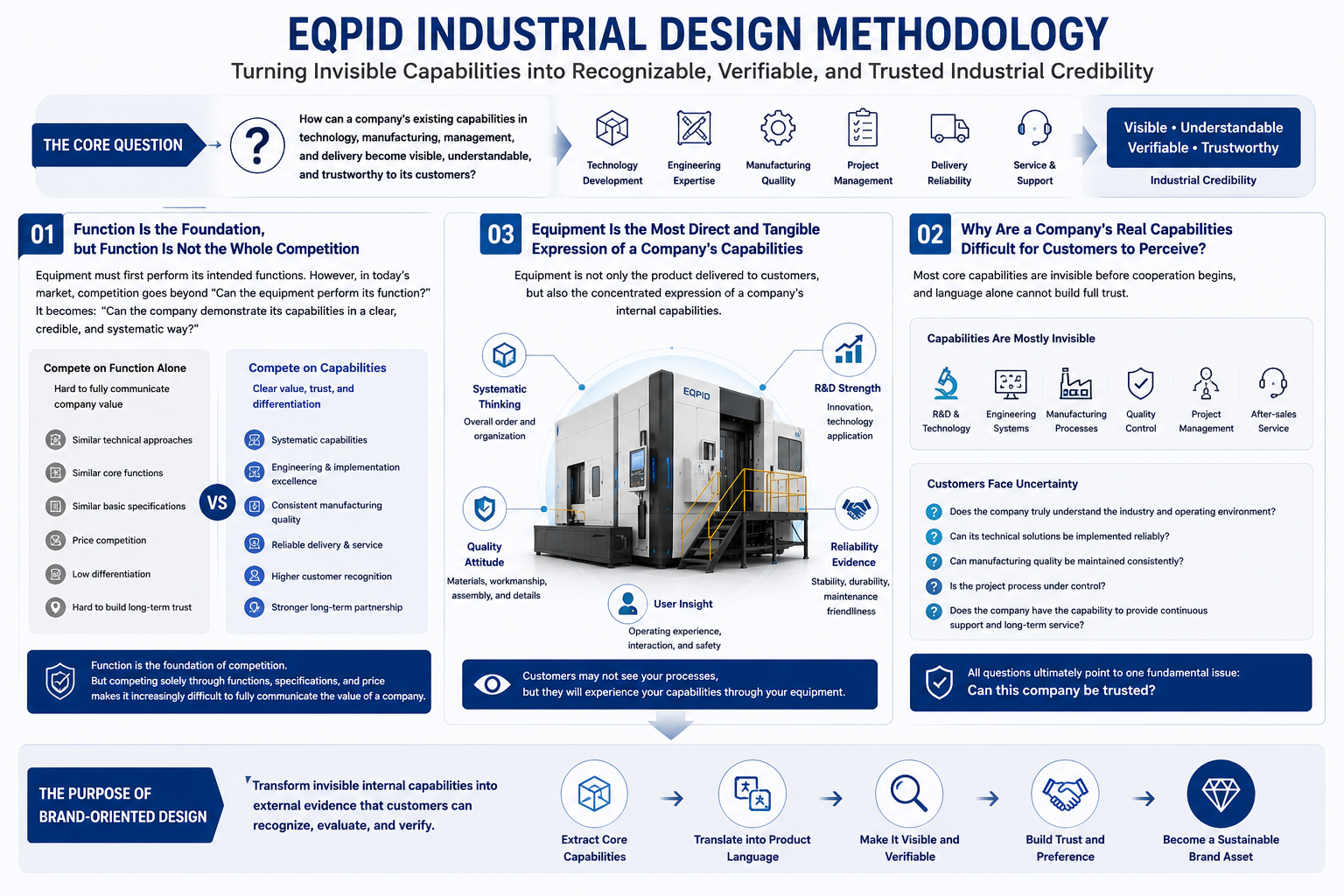
This means that industrial design for large equipment cannot rely solely on an approach centered on styling concepts and visual renderings. Design must begin with function, users, application scenarios, structure, manufacturing, transportation, installation, and long-term maintenance, while also taking responsibility for communicating the company’s brand and building customer trust.
The later design decisions enter engineering and manufacturing, the higher the cost of modification. The greater the gap between the initial visual expression and the final physical product, the stronger the customer’s doubts about the company’s capabilities.
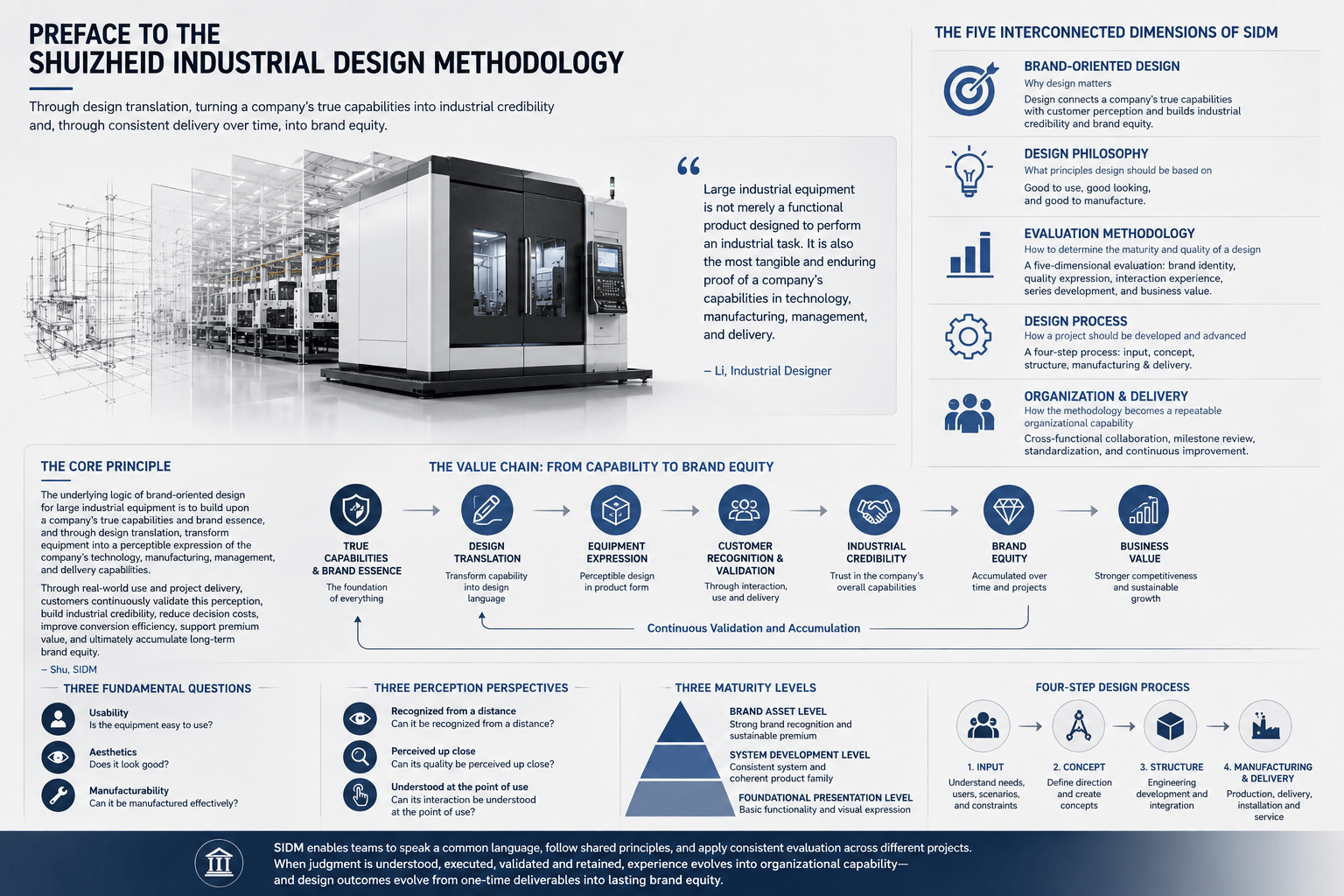
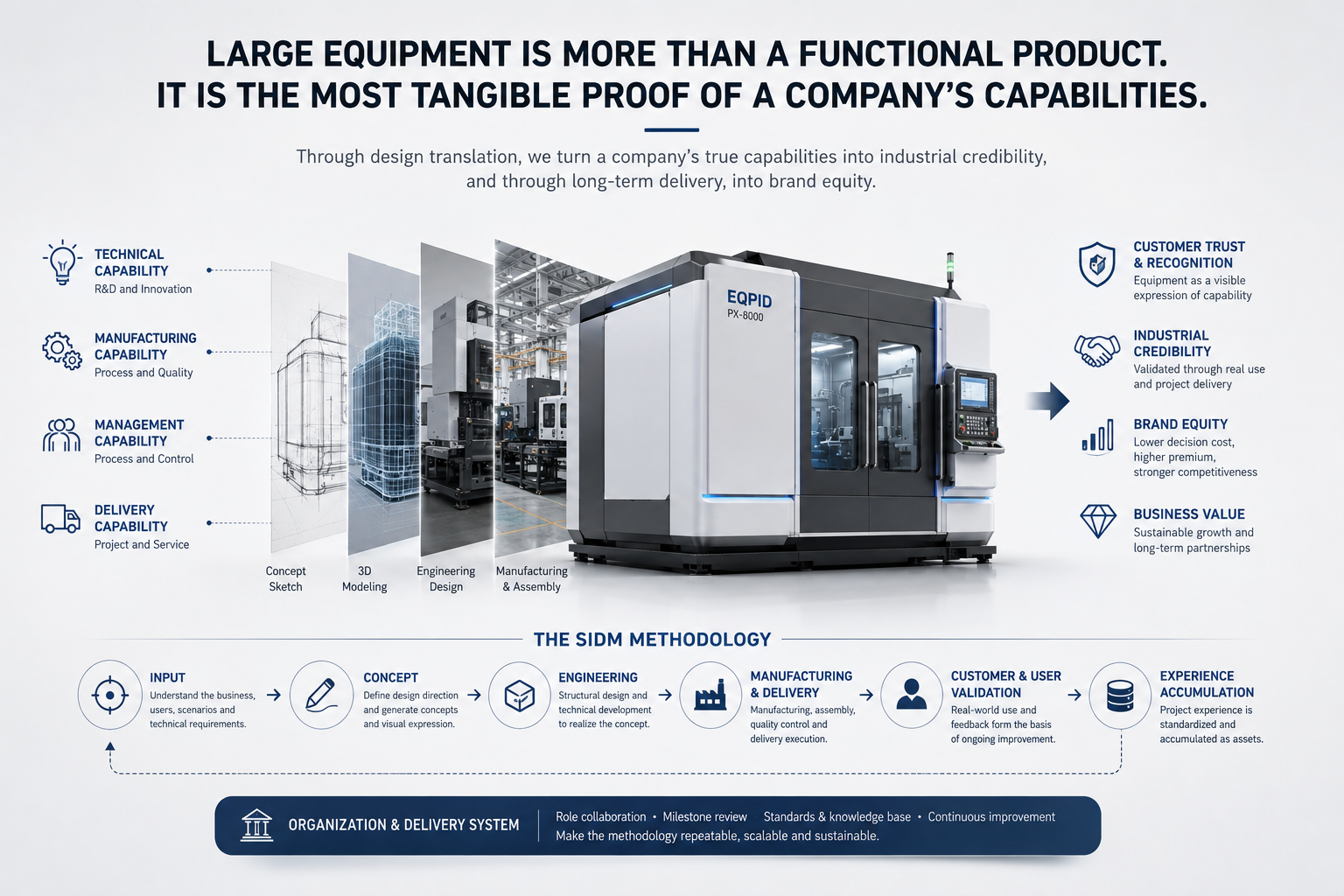
Therefore, EQPIDM understands large equipment design as a continuous value chain:
Design input establishes direction → Concept design creates expression → Structural engineering carries the concept forward → Manufacturing and delivery validate the result → Customers and users form their judgments → Project experience is further transformed into rules and brand assets.
When any link in this chain is disconnected, the value created in previous stages may be weakened in subsequent stages.
“SIDM is not a styling language. It is a systematic design methodology that enables large industrial equipment to evolve from functional products into brand assets.”
— Li, Industrial Designer
2. Scope of Application of EQPIDM
The large industrial equipment discussed in this book primarily refers to B2B equipment designed for organizational customers, performing specialized industrial tasks, and requiring coordination between engineering design, manufacturing, and delivery.
Equipment with a volume of approximately 0.3 cubic meters or more may serve as a practical reference point, but this is not an absolute boundary.
A more important consideration is whether the product exhibits characteristics such as:
- Complex engineering systems
- Long service cycles
- High customer decision risk
- Strong relationships with the physical application environment
- Long manufacturing and delivery chains
- Collaboration among multiple stakeholders
EQPIDM can be applied to the upgrading of individual machines, the development of product series, the establishment of branded product systems, and integrated delivery covering exterior design, structural design, processing, and manufacturing.
Equipment that is relatively small in physical size but shares the same B2B decision-making and engineering-delivery characteristics can also benefit from EQPIDM.
For products primarily focused on fast-moving consumer markets, pure software experiences, or core technology R&D, EQPIDM can provide partial reference but should not be applied mechanically.
3. Three Fundamental Roles
To avoid the role confusion commonly found in large equipment projects, this book uses three consistent terms.
Enterprise refers to the organization that manufactures and sells the equipment and fulfills its product and delivery commitments to the market.
Customer refers to the organization that purchases the equipment, organizes the procurement decision, and assumes responsibility for the project outcome.
User refers to the people who operate, observe, maintain, inspect, and manage the equipment in real-world environments.
Customers and users may belong to the same organization, but their priorities are not necessarily the same.
Customers are more concerned with:
- Investment value
- Corporate reliability
- Project risk
- Delivery schedules
- Service
- Long-term cooperation
Users are more concerned with whether the equipment is:
- Clear to understand
- Smooth to operate
- Safe
- Reliable
- Easy to maintain
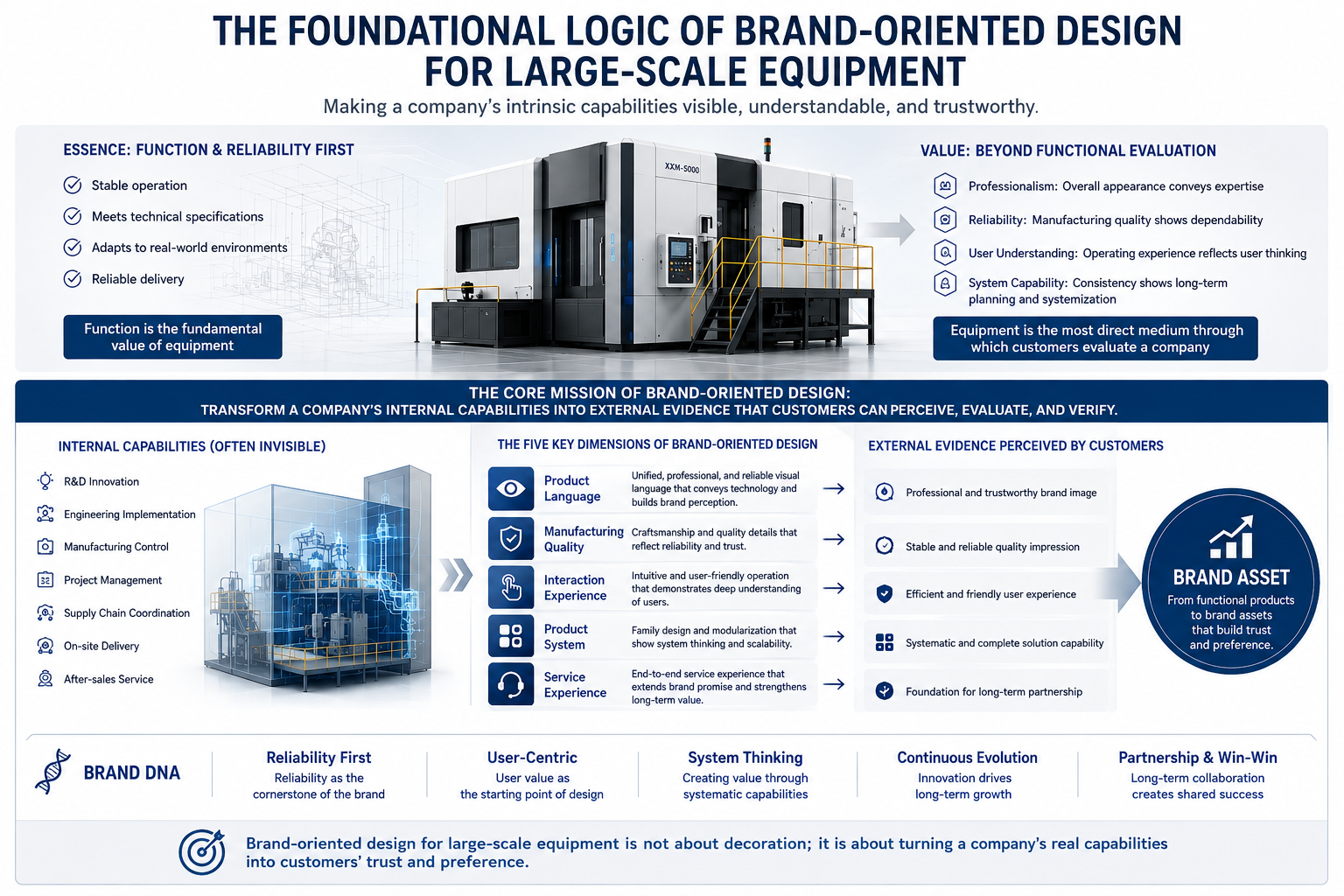
Brand-oriented design for large industrial equipment must respond to both.
Customers determine whether a company is chosen. Users determine whether the equipment earns genuine acceptance through long-term use.
4. Core Structure of EQPIDM
StructureRoleCore QuestionValue FoundationEstablish the value propositionHow can a company’s true capabilities be transformed into industrial credibility and brand equity?Three Design PhilosophiesProvide principles for design decisionsIs the equipment functional, visually compelling, and manufacturable?Five Evaluation DimensionsDefine what should be evaluatedBrand identity, quality expression, interaction experience, product series development, and commercial valueThree Maturity LevelsDetermine the maturity of the designFoundational Presentation, Systemic Development, Brand AssetThree TouchpointsReturn evaluation to real-world perceptionRecognized from a distance, quality perceived up close, interaction understood at the point of useFour-Step Design ProcessDrive project implementationInput, Concept, Structure, Manufacturing & DeliveryOrganization & Delivery MechanismEnable long-term replicationRole collaboration, milestone reviews, standards development, and continuous improvement
These structures are not competing models or separate systems.
The three design philosophies serve as the principle coordinates throughout the project process.
The five evaluation dimensions serve as the coordinates for evaluating outcomes.
The three maturity levels provide a framework for assessing development maturity.
“See from a distance, understand up close, interact at the point of use” provides the perception coordinates for customers and users.
The four-step process provides the coordinates for time and execution.
The organization and delivery mechanism ensures that all these judgments can transcend individual people and individual projects and continue to exist within the organization.
5. The Core EQPIDM Model
“A Company’s True Capabilities + Brand Essence → Design Translation → Perceptible Product Expression → Customer Recognition, Judgment & Real-World Validation → Industrial Credibility → Brand Equity → Business Value”
— Shu, EQPIDM
Industrial credibility is the critical turning point within this value chain.
In this book, industrial credibility does not refer to a company's legal credit rating, nor does it refer to an abstract sense of brand favorability.
Rather, it refers to the comprehensive judgment and trust that customers develop regarding a company’s technology, manufacturing, management, and delivery capabilities through the equipment itself, the project process, real-world use, and consistent delivery over time.
Design can provide clear and credible evidence for this judgment, but it cannot create credibility independently of the company’s actual capabilities.
6. How to Use This Book
Business leaders can use EQPIDM to determine whether product development is moving toward the creation of long-term brand equity.
Product and marketing teams can use it to define customer perception objectives and product-series directions.
Project managers can use it to clarify project inputs, control key milestones, and facilitate cross-functional collaboration.
Industrial designers can use it to establish a clear basis for evaluating design proposals.
Structural and manufacturing teams can use it to understand which design relationships must be carried through into engineering and production.
Customers and users can participate in evaluation through the maturity model and real-world touchpoints.
A company does not need to enter the Brand Asset Level in a single step.
It can begin with the weakest dimension, first establishing a basic product expression, then developing systematic rules, and ultimately accumulating brand equity through long-term delivery.
What matters is that every project clearly identifies its current state, its next direction, and the capabilities that need to be retained and developed for future projects.
KEEP READING