CASE STUDY
A problem-list-driven redesign for a sludge dewatering machine: an enclosed roll zone for washdown, safety isolation, a maintenance-first panel layout, and a chamfered skirt line that turns process capability into visible form.
In a wastewater plant's dewatering workshop, the sludge dewatering machine is arguably the hardest piece of equipment to keep presentable: slurry, water and flocculant alternate around the clock, leaving rollers, frames and floors permanently wet. When a manufacturer of environmental equipment set out to finalize its next-generation machine for mass production, the brief to us was blunt — don't just wrap the shell; first think through the problems operators face every single day.
So the design input was not "make it look better." It was a problem list brought back from the field, and the entire design answers it item by item.
On the original machine, the dewatering roller and its assembly were almost entirely exposed — slurry splash and fiber fouling made every cleanup a cautious affair, and high-pressure washing always had to avoid the driveline.
The redesign wraps the machine in a unified enclosure and tucks the roll zone into a shell that keeps a clear visual relationship with the process. Washing can now be done without second thoughts, and sludge water no longer reaches critical components.
The enclosure surface is divided into large, minimal panels with no redundant seams — the fewer the seams, the fewer places for sludge to hide. The panel rhythm follows the body line, with the main seams held on a single horizontal band: visually calmer, and a washdown only needs to follow that one line. Corners soften into rounded transitions, with no sharp edges or sludge-trapping recesses — in a wet zone, every detail works for easy upkeep.
One principle from the Shuizhe methodology: maintenance design should support servicing, inspection and management across the equipment's entire life cycle. For a sludge dewatering machine, "maintainable" is not an add-on — it is the precondition for the machine to keep working well for years.
Exposed rollers are hard to clean — and they put danger within arm's reach. Rotating parts in the press zone and accidental contact during servicing are the most typical on-site risks.
The enclosure isolates the hazardous zone in operation. Observation windows are a key move: operators can confirm the roller's running state without opening any panel — the process stays visible while staying out of reach. Openable maintenance faces are distinguished from surrounding areas by an explicit opening logic: what opens, which way it swings, and where it stops are all answered by the form itself. Being legible is itself a form of protection.
Another baseline judgment from the methodology: safety is the baseline condition of usability — convenience must never be traded against missing safety conditions. The enclosure exists for safety first, and for looks second. That order cannot be reversed.
The most common objection to full enclosure: the tighter it is wrapped, the harder the servicing?
That is why the panel layout was planned around maintenance paths from day one — doors and panels correspond one-to-one with areas that need regular contact: large panels, minimal fasteners, unified opening directions. Routine checks need no toolbox; deep servicing never requires dismantling the whole machine. Visual cleanliness and maintenance ease come from the same seam logic.
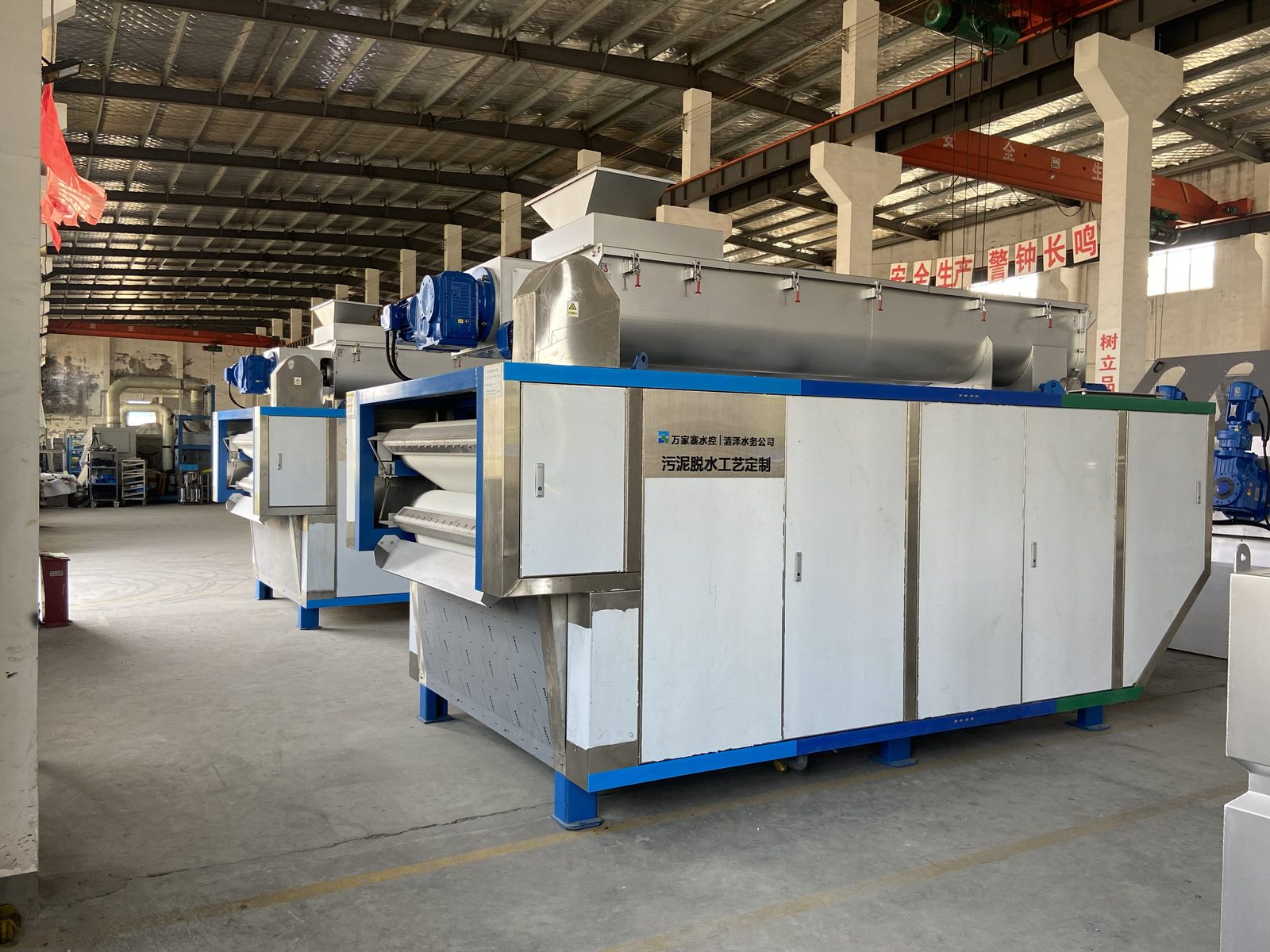
The original image was the industry's most common look: a flat sheet-metal box in the habitual blue-and-white scheme, indistinguishable from any similar machine on the shop floor.
The redesign introduces a continuous chamfered skirt line along the lower body, running from head to tail like a hem pulled tight, giving the long body a calm, crisp stance. The skirt is more than decoration: it tucks the irregular outlines of the lower roller assembly and pipework into visual shadow, leaving the side elevation a clean, complete volume.
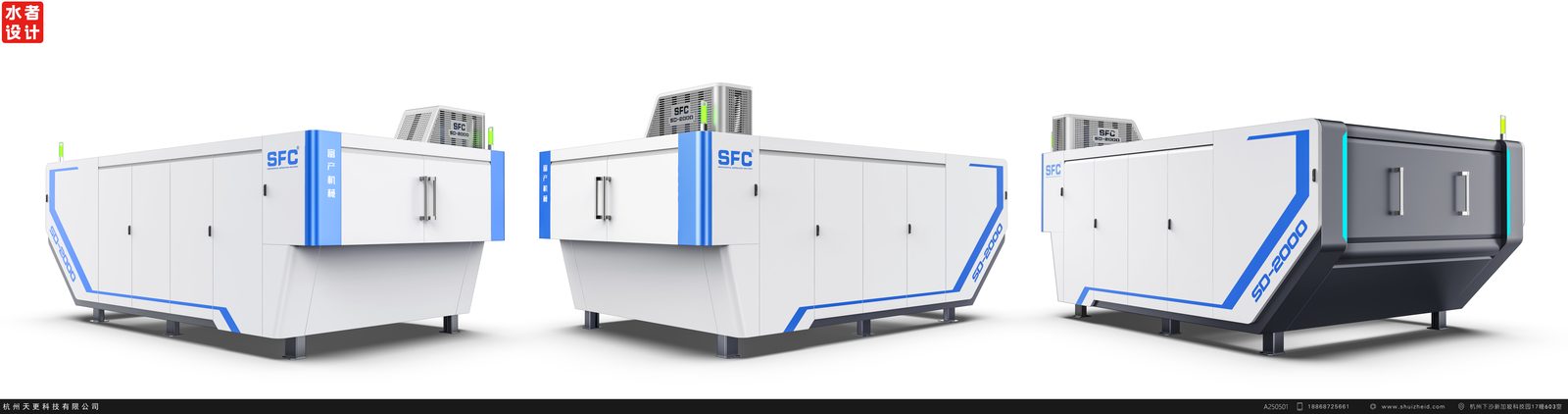
The color scheme is equally restrained. On the white base, blue appears only on the skirt's angled faces and accent bands — and because those faces catch the light, the blue shifts in tone with the viewing angle, giving the stationary body a sense of motion. The large light-colored surfaces keep the workshop bright, while the blue accents make the machine instantly recognizable in a row of similar equipment: from afar, one clean volume; up close, the shifting light on the chamfers gives every angle a subtle difference.
The head of the machine reserves a brand position for the client, with the SD-2000 model mark placed naturally on the primary sightline face. Up close, the panel layout, door seams and handles all follow the same logic: large panels, minimal fasteners, unified opening directions. Recognition here does not rely on stickers or slogans — it relies on a skirt contour competitors cannot copy, and a formal order that runs through the whole machine.
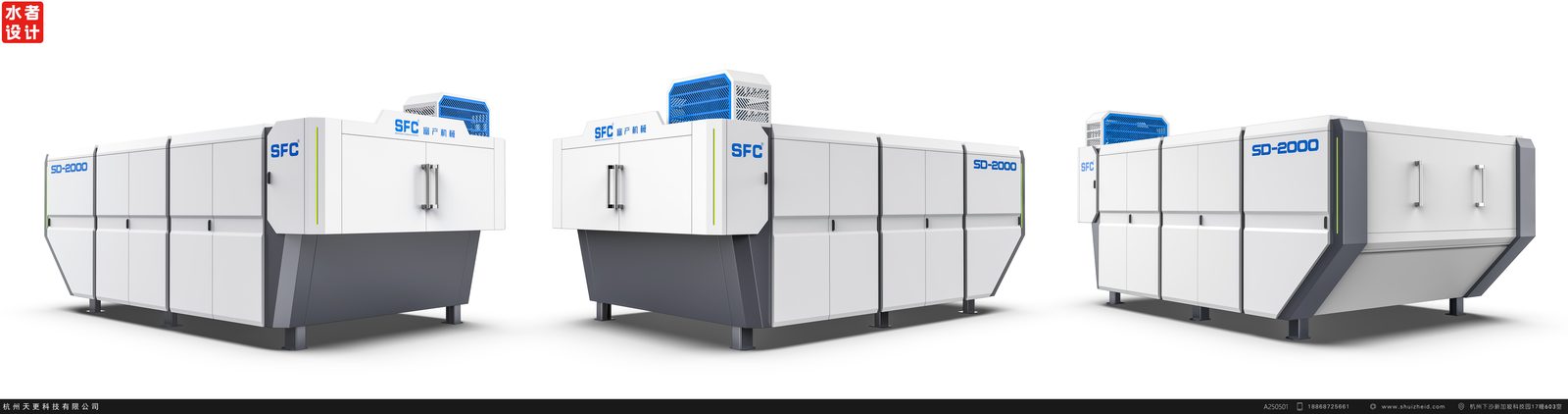
The client's core capability is customizing dewatering processes — different sludge, different conditions, different solutions. But a buyer standing in front of the machine cannot see process parameters; they only see the machine itself.
The translation design performs is to turn "we understand sludge dewatering" into visible formal order, tangible panel seams, and maintenance faces that simply work. The machine itself is this company's most honest business card.
The next time plant operators gather around it for routine washing, we hope every item on that original problem list gets crossed off, one by one.